
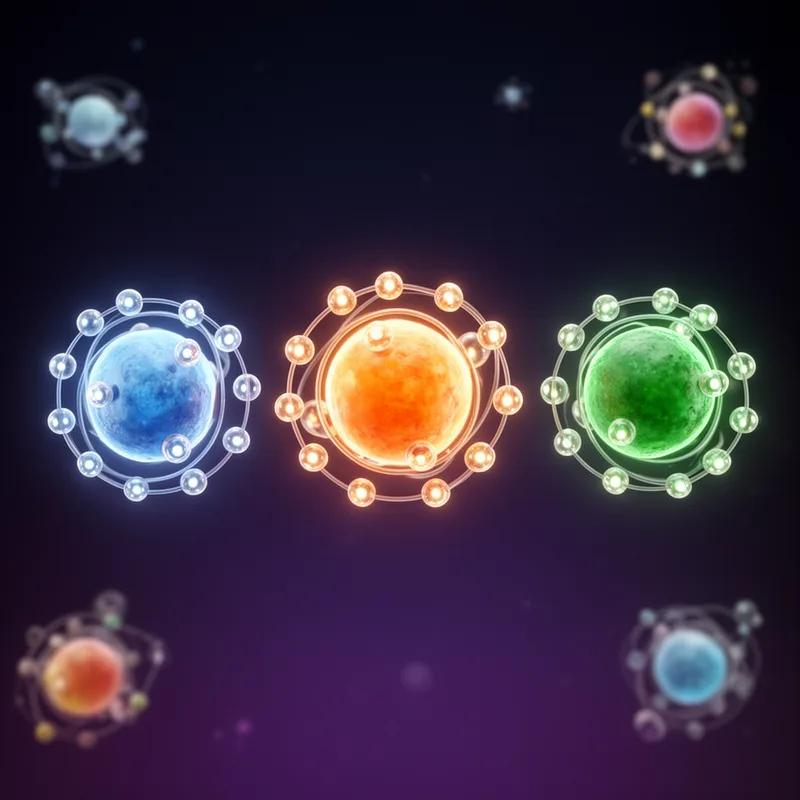
isoelectronic


 1
9.1
- adjective
- /ˌaɪsoʊɪˈlɛktrɒnɪk/
- Specialized
- Some isoelectronic species, like neon and argon, share similar chemical properties due to their electron configuration.
Examples
-
When studying isoelectronic ions, it is important to consider their size and charge to understand their behavior in reactions.
-
Two atoms of the rare gas xenon are isoelectronic with CsI and condense either at low temperature or at moderate pressure to form a cubic crystal, but its structure and bonding are entirely different.
Academic text (1998) -
Well, this is isoelectronic with helium, right?
-
So let's do a quicker question on isoelectronic atoms.
-
The nitrogen ion and the oxygen ion are isoelectronic because they both have eight electrons.
Surface Forms
Morphology
isoelectronic = electronic (semi-transparent) = iso + electron + ic
The form is analysable as iso- ('same') + electronic, but the precise technical sense ('same number of electrons / same electronic structure') is domain-specific and may not be deducible by a general B1 learner.
Etymology
Isoelectronic comes from the part iso- meaning 'equal' and electron meaning 'a tiny charged particle'. So, isoelectronic describes atoms or ions that have the 'same number of electrons' or the same electron arrangement, which is why they often behave in similar ways.