
isentropic


 1
9.9
- adjective
- /ˌaɪsɛnˈtrɒpɪk/
- Specialized
- In the ideal version of the vapor-compression refrigeration cycle (Figure 3), process 1-2 is one of isentropic compression, with the refrigerant initially entering the compressor as a saturated vapor and leaving in a superheated state.
Examples
-
The real explanation for the difference has turned out to be that sound is adiabatic and isentropic, but Newton had assumed implicitly that it was isothermal instead.
Academic text (1991) -
So you've got an isentropic expansion.
-
It would become isentropic, not isothermal.
Blog text (18) -
And so here you recognize the inverse of the isentropic compressibility.
-
It will become isentropic.
Blog text (18) -
Mechanical disturbances create isentropic pressure fluctuations that propagate as phonons with the speed of sound in water.
Academic text (2011) -
It should also have isentropic compression, no subcooling (for R-22), and no suction superheating.
Academic text (1998) -
The logic I used in coming to my conclusion involved nothing but quasi-static reversible adiabatic processes, which by definition are also isentropic, but I was ignoring my own point (5) while thinking through point (2).
Blog text (18) -
In thermodynamics, an isentropic process is one in which the system's entropy remains constant.
-
For an ideal gas, the isentropic expansion occurs without any heat exchange with the surroundings.
Surface Forms
Morphology
Etymology
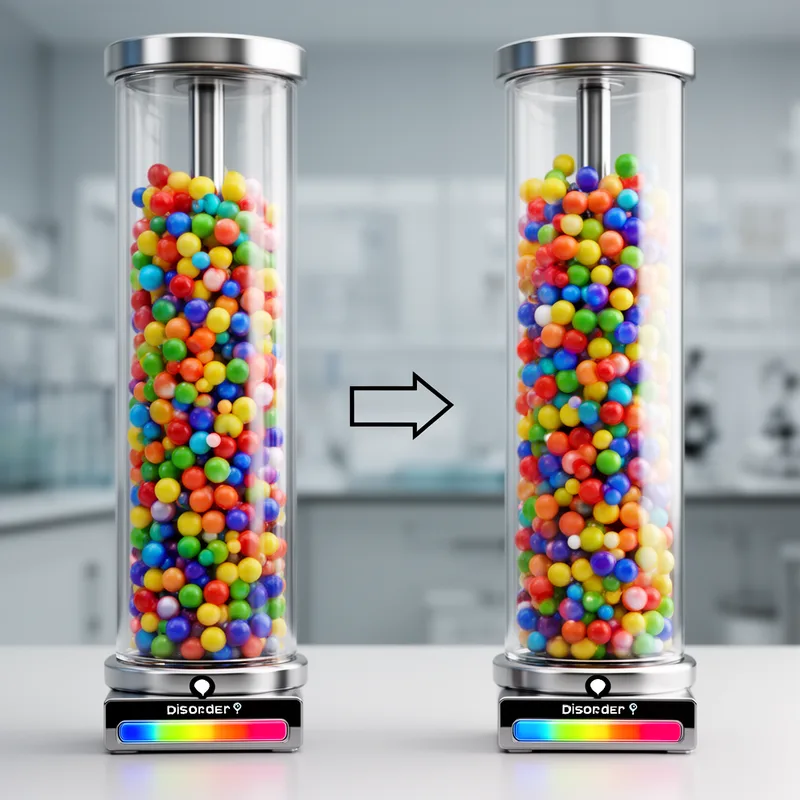
Isentropic combines the prefix iso- meaning 'equal' and entropy, a measure of a system's 'disorder' or how much energy cannot do work. So isentropic describes a process where entropy stays the same — no entropy is added or lost.