

ischemia
 5
8.5
5
8.5

- noun
- /ɪsˈkiːmiə/
- Specialized
- More than 80% of patients progress to ischemia, necrosis, pulp atrophy, and gangrene.
- myocardial ischemia
- limb ischemia
- cerebral ischemia
Loading YouTube…
Watch on YouTubeParatomic mesenteric ischemia is very painful.
- Paratomic mesenteric ischemia is very painful.
Examples
-
None of the fractured digits showed evidence of ischemia at the time of injury. Case 1
Academic text (2012) -
Paratomic mesenteric ischemia is very painful.
-
Six of such patients later developed advanced ischemia and gangrene prior to a proper diagnosis.
Academic text (2007) -
Patient brought in with chills, nausea, ischemia, clearly in shock.
-
Presentation included acute limb ischemia in 13 patients with pain and paresthesia.
Academic text (2007) -
What they've also found now with these women with this type of ischemia is that they have endothelial dysfunction.
-
Most patients with proximal arterial occlusion will have large areas of ischemia and an NIHSS score of 8.
Academic text (2015) -
With prolonged periods of microcirculatory ischemia, necrosis of the intracompartmental tissues, including muscle and nerve tissue, results.
Academic text (2004) -
The first pair of bars corresponds to those patients who showed myocardial ischemia, post-stress ventricular dysfunction, and endothelial dysfunction.
Academic text (2007) -
A restriction of blood supply, known as ischemia, can lead to severe pain in the affected area.
Synonyms
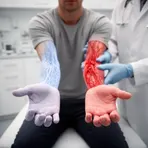
Not enough blood in a body part to make it work properly

A lack of oxygen in body parts because not enough blood reaches them

Lack of oxygen in parts of the body because blood flow is stopped or very slow
Antonyms



How Severe

Surface Forms
Morphology
ischemia = isch + emia
A technical medical term built from Greek combining forms (isch- + -emia) that are not standalone English words, so an average B1 learner cannot reliably infer the meaning from the parts.
Etymology
Ischemia comes from Greek parts meaning 'to hold back', isch-, and 'blood', haima, and it even shares the 'blood' root with hemorrhage. So, ischemia is when blood is 'held back' from part of the body, which explains why it can cause damage.