
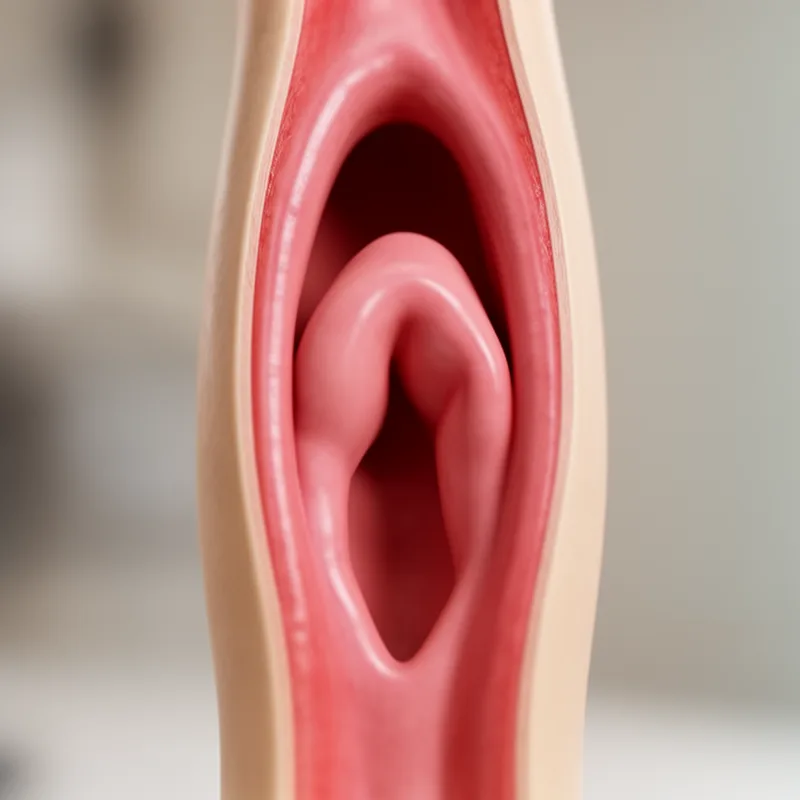
invagination
- noun
- /ˌɪnvædʒɪˈneɪʃən/
- Specialized
- Invaginations figured as enveinments or as subsurface channels open up potentials of connected networks and are congenial to the kinds of historical projects that trace underlying linkages.
Examples
-
CAV-1 is a cell surface protein that is necessary to form invaginations in the cell membrane, which impacts intracellular vesicle transport, cell cycle control, and apoptosis 44, 56, 77.
Academic text (2017) -
Have you experienced the sensuosity of marginal invagination?
Fiction book (1994) -
But after the gastrula is formed, OK, by an invagination of the, of the, the blastula, the gastrula forms and then the narrow plate appears.
-
The inverse of a distanced projection would be something like an intimate or continuous invagination, which is one of the things a cave is, in relation to the geologic surface, and one of the things an ocular organ is as well.
Academic text (1994) -
During early development, the embryo undergoes an invagination which creates the digestive cavity.
-
In histology classes, we learned about invagination as a mechanism in cell membrane formation.
-
The invagination of the tissue helped to create a pouch for the developing organ.
Synonyms

 1
9.9
1
9.9

A folding of part of a structure inward that forms a pocket

A surface that turns inward to form a small pocket

A body part folds inward in a living thing
How Deep
- Specialized
70
4.1

- Specialized
5
4.2
13
3.7
84
2.4
Surface Forms
Morphology
invagination = invaginate (semi-transparent) = in + vagin + ation
Formed from the verb 'invaginate' with the noun-forming suffix '-ation', but the combining form 'vagin-' (meaning 'sheath') is not a standalone modern English morpheme, so the derivation is only partially obvious to learners.
Etymology
Invagination comes from the Latin parts in- meaning 'into' and vagina meaning 'sheath' or 'cover'. So the idea is 'folding into a sheath', which explains why invagination means tissue folding inward to form a pouch or pocket.