
interrupt
 3
7.0
3
7.0

- noun
- /ˈɪntərʌpt/
- Specialized
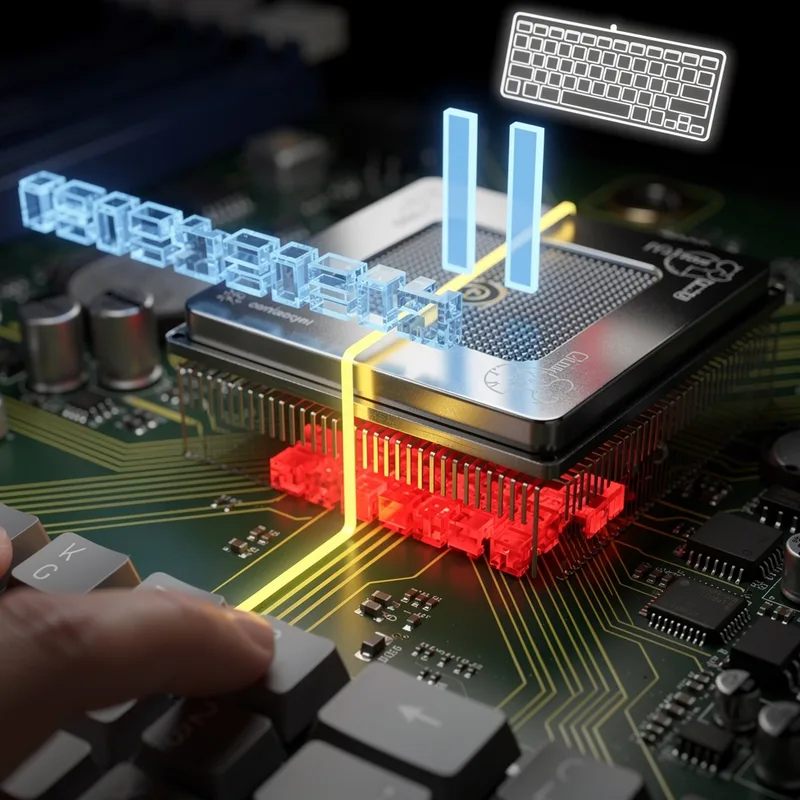
- When an interrupt is received, the processor stops its current tasks to execute a higher priority function.
- interrupt handler
- External interrupt
- asynchronous interrupt
Examples
-
In the case of multiple interrupts, the hardware must select a single interrupt to service.
Academic text (1994) -
Finally, the ICU can restore a previous CR value if an interrupt occurs.
Academic text (1994) -
And the first one is a timer set up here that runs an interrupt which sends data to the shift register.
-
The actual device posts a physical completion interrupt, which is handled by the hypervisor.
Academic text (2012) -
The MSR and the type of interrupt determine the interrupt vector to which the machine branches.
Academic text (1994) -
If one is, the processor is serialized to allow the asynchronous interrupt logic to correctly present the interrupt.
Academic text (1999) -
The ICU alters the MSR according to the type of interrupt: bus interface.
Academic text (1994) -
In addition to managing these interfaces, the SCU contains logic for external interrupts and the performance monitor.
Academic text (1994) -
The Nucleus, written in verified assembly language, implements allocation, garbage collection, multiple stacks, interrupt handling, and device access.
Academic text (2011) -
In POWER2, hardware support for a floating-point imprecise interrupt was also added in order to aid in software debugging.
Academic text (1994)
Synonyms
 109
2.3
109
2.3
A stop in movement or activity
 99
3.0
99
3.0
A short time when something stops or is delayed
Antonyms

How Long

Surface Forms
Morphology
interrupt = interrupt (semi-transparent) = inter + rupt
The noun is transparently related to the verb 'interrupt' in the sense of something that stops or breaks a process.
Etymology
The noun interrupt in computing has the same parts, inter- 'between' and rupt 'break', and it is a short 'break' that stops a program so the computer can deal with something more important.