

incendiary bomb
 1
6.3
1
6.3

- noun
- /ɪnˈsɛndiˌɛri bɑm/
- Specialized
- During World War II, cities were devastated as incendiary bombs ignited massive fires.
- drop incendiary bombs
Examples
-
She is taping the claymores to the gas cans with duct tape to create powerful incendiary bombs.
Fiction book (1991) -
Three years later, in 1941, Liverpool Museum was hit by an incendiary bomb during the Blitz, and, tragically, some of the ethnographic material was destroyed in the resultant fire.
Academic text (1998) -
About 0330 hours, a Japanese plane dropped an incendiary bomb along our line.
Fiction book (1990) -
Incendiary bombs were falling on the city beneath the vault of an evening May sky.
Fiction book (2001) -
In the Pacific, B-29s delivered a variety of aerial weapons: conventional bombs, incendiary bombs, mines, and two nuclear weapons.
Blog text (20) -
Bats with incendiary bombs attached to them or crows with radioactive cluster bombs attached to them.
-
More than 100,000 acres were burned by midsummer, and some fires were reported to have been set by aircraft dropping incendiary bombs.
Academic text (1999) -
The balloons were filled with fragmentation and incendiary bombs designed to self-destruct upon descending into the American forest.
Blog text (25) -
The statute thus proscribes the use of any incendiary bomb or grenade, including one with a wick and a breakable container.
Blog text (17) -
The military used incendiary bombs to target enemy fuel depots and buildings.
Synonyms
 7
6.6
7
6.6
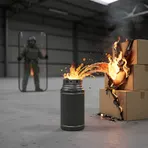
A bomb that starts fires, often used against buildings or fuel
 6
7.3
6
7.3
A weapon made to start fires using chemicals
 1
7.1
1
7.1
A bottle filled with petrol and a burning rag, thrown to start a fire
 1
8.5
1
8.5
A device made to start fires in buildings or fuel stores
 1
7.4
1
7.4
A simple weapon that uses a bottle of gasoline and a cloth wick to start fires
How Destructive
- Offensive
24
9.6

- Specialized
11
8.6
- Specialized
1
6.3
- Offensive
7
6.6
- Offensive
9
8.1
Surface Forms
Morphology
The meaning is directly compositional: 'incendiary' means causing or designed to start fires and 'bomb' is an explosive device, so a learner who knows both constituents can infer a bomb intended to start fires. This follows a transparent modifier + noun pattern found across languages, making the expression predictable for B1 learners.
Etymology
Incendiary bomb comes from incendiary, which means 'to start fires', and bomb, which is a thing that explodes, so it names a bomb made to cause big fires.