
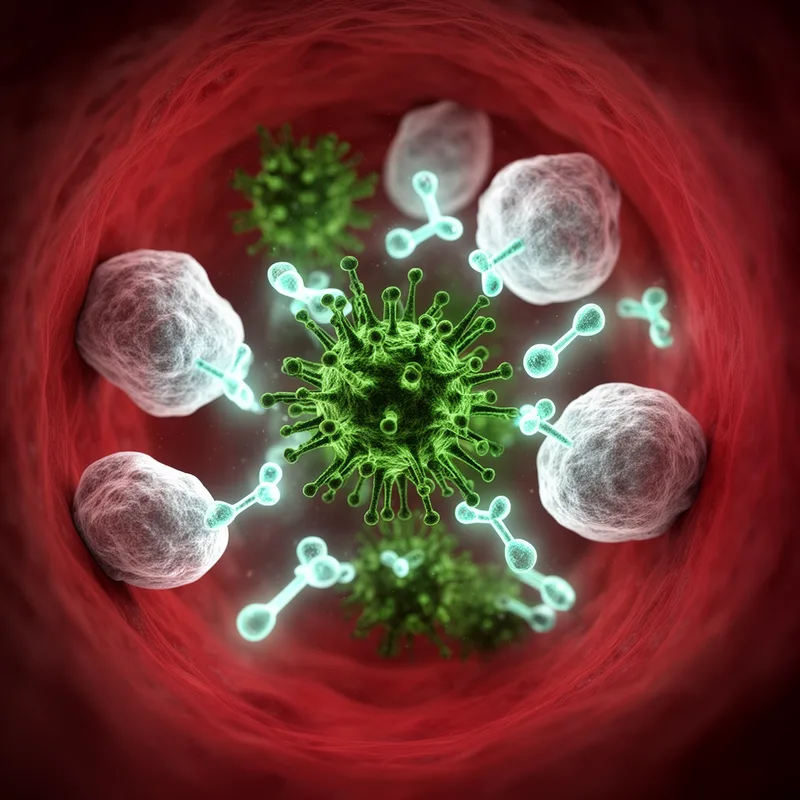
immune response
 11
4.4
11
4.4

- noun
- /ɪˈmjun rɪˈspɑns/
- Specialized
- When a virus enters the body, it prompts an immune response that produces antibodies.
- humoral immune response
- cellular immune response
- innate immune response
Loading YouTube…
Watch on YouTubeAnd that is going to trigger an immune response to your own proteins.
- And that is going to trigger an immune response to your own proteins.
- That can mean that our immune response wears out.
- And so he had a massive immune response because you have an immune response to virus particles.
- So it's, it binds and releases these common pesticides and, and dampens or protects the immune response as a result of it.
- He selected for mutations that made the virus not 'cause disease but still make an immune response.
- When you cause physical trauma in the skin, you recruit a much larger immune response than what was warranted for that insult.
- However, when when you were injected with that bacterial toxin, you had no negative immune response apart from a minor headache.
Examples
-
First, phagocytes trigger the immune response by sending macrophages and dendritic cells into the blood.
-
Adjuvants are substances added to the vaccine to enhance the immune response to it.
Academic text (2015) -
So eggs can contribute to that immune response for, for some people.
-
Now, we referred to the fact that the immune response can be problematic.
-
And that is going to trigger an immune response to your own proteins.
-
That's why you can have an immune response in some people.
-
These are the major outer proteins that cause an immune response and are protective.
-
And that's due to your body's immune response to the virus.
-
We've been using vaccines since the time of Jenner to generate an immune response against pathogens.
-
Perinatal exposure to PCBs has also been shown to adversely impact immune response to routine childhood immunizations.
Academic text (2010)
Synonyms
 1
3.2
1
3.2
The body's defence that attacks foreign things like germs or transplanted organs

The body's reaction that makes antibodies and sends cells to fight germs
How Strong
- Specialized

- Specialized
11
4.4
Surface Forms
Morphology
The meaning is directly compositional: 'immune' (protected by the immune system) + 'response' (a reaction) yields 'the immune system's reaction.' This adjective+noun combination follows a standard, cross-linguistically common pattern and is readily inferable by a B1 learner who knows the constituents.
Etymology
Immune response gives a picture of the body as an army. When 'invaders' like viruses or bacteria appear, the body's 'soldiers' called 'antibodies' rush to attack, so immune response means the body's 'reaction' to fight off these threats.