

immobilization
- noun
- /ɪˌmoʊbɪlaɪˈzeɪʃən/
- Specialized
- After a fracture, the doctor recommended immobilization of the arm in a cast to aid healing.
- cervical immobilization
- rehabilitation following immobilization
- immobilization (casting)
Examples
-
There are adverse effects associated with the immobilization of the knee after ACL reconstruction.
Academic text (2005) -
Most pediatric tibia fractures can be managed nonoperatively with reduction and immobilization techniques (see Figure 14).
Academic text (2006) -
All patients were treated with closed reduction and plaster cast immobilization for 6 to 7 weeks.
Academic text (2017) -
Twenty years ago, rehabilitation included immobilization of the leg for 6 weeks or longer after an ACL injury.
Academic text (2005) -
The growth plate and periosteum allow for faster healing and shorter immobilization times.
Academic text (2006) -
Traditional treatment for patients with shoulder instability has included immobilization, rehabilitation, and gradual return to activities.
Academic text (2003) -
If there is no displacement, the fracture can usually be treated with immobilization in a long-leg cast.
Academic text (2006) -
Most fractures of the distal tibia/fibula require immobilization for 6-8 weeks.
Academic text (2006) -
Atraumatic shoulder instability is currently being treated appropriately with immobilization, rehabilitation, and a gradual return to vigorous activities.
Academic text (2003) -
Rowe (1956) retrospectively evaluated the effect immobilization had on recurrent dislocations.
Academic text (2003)
Synonyms

 4
6.3
4
6.3

A state of no movement or not being able to move


 1
4.0
1
4.0
Putting a firm support on a hurt body part to keep it still
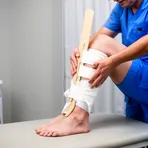
Using a firm support to hold an injured arm or leg still so it can heal

An action that stops a person or thing from moving
Antonyms

How Immobilized

Surface Forms
Morphology
immobilization = immobilize (transparent) = im + mobile + ize + ation
Formed by adding '-ation' to the verb 'immobilize' (itself im- + mobile + -ize), producing a noun meaning the act or process of making immobile.
Etymology
Immobilization comes from the Latin parts in- 'not' and mobilis 'movable', the same root you see in mobile. In medicine, immobilization means keeping a limb very still with a cast or splint so a bone can heal in the right place.