

immiscible
- adjective
- /ɪˈmɪsəbl/
- Specialized
- His comments also point to one of the cores of apartheid propaganda: that people of different colors are so clinically immiscible that any interaction across racial lines is nearly impossible.
Examples
-
Please see http://www.FactCheck.org, and/or some of the other nonpartisan online fact checkers for the objective truth—which is that R/R and truth are almost totally immiscible.
Blog text (3) -
So it looks like the extended list is a more useful idea and immiscible idea, right?
-
On the other hand, water and most oils are immiscible, usually forming layers according to increasing density from the top.
Blog text (34) -
By selecting two of the three states of the F = 1 spinor condensates, we could produce two-component condensates that were either miscible or immiscible.
Academic text (1999) -
Those two streams of thought—the study of the very small and of the very large—remain immiscible in physics, even though they readily coexist in the same physical universe.
Academic text (2005) -
When mixed in a container, water and oil remain immiscible, forming separate layers instead of blending together.
-
The scientist demonstrated how two immiscible liquids do not combine, highlighting their distinct properties.
-
In a chemistry experiment, students observed that alcohol and water are immiscible when shaken in a bottle.
Synonyms

Liquids that do not mix, like oil and water, form separate layers
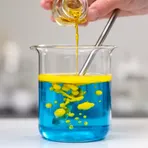
Cannot combine with another substance to form a single even material
Antonyms
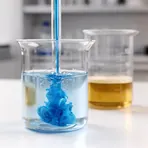


How Miscible
- Specialized

 1
8.4
1
8.4

- Specialized
Surface Forms
Morphology
immiscible = miscible (semi-transparent) = im + miscible
The formation is a straightforward negative prefixation (im- + miscible), but the Latinate stem 'misc-' and the relatively uncommon base 'miscible' (orthographically different from the common verb 'mix') may make the relation less immediately clear to learners.
Etymology
The word immiscible breaks into in- meaning 'not' and the root misc meaning 'mix', the same root you see in the everyday word 'mix'. So, immiscible means 'not able to mix' and is used for liquids like oil and water that stay in separate layers.