
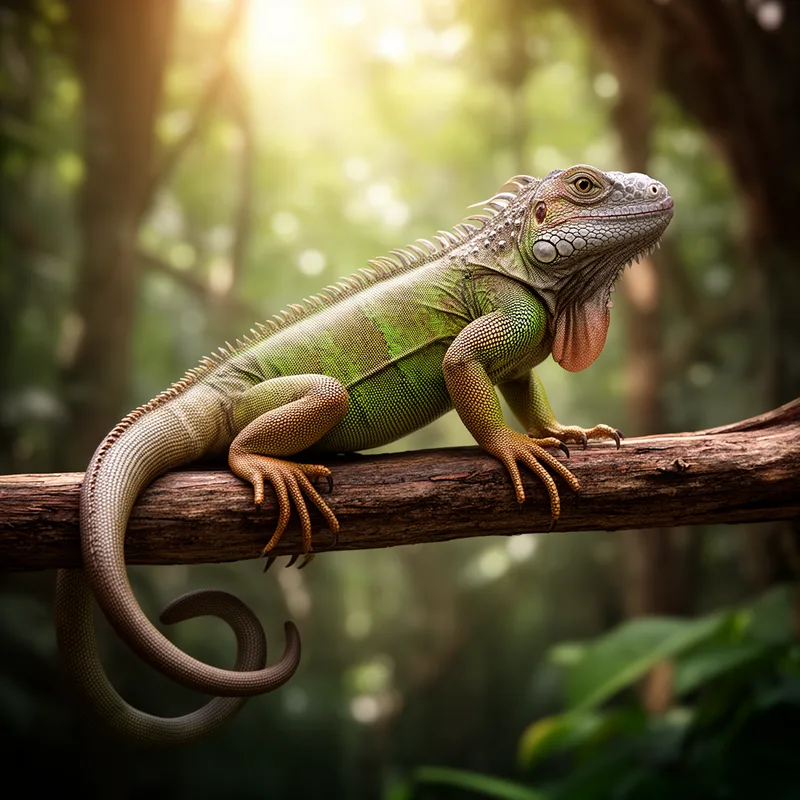
iguanian
- noun
- /ɪˈɡwɑːniən/
- Specialized
- Chameleons are iguanians, most of which manipulate prey with the tongue, though a few are vegetarians.
- most iguanians
Examples
-
Most iguanians are territorial, fiercely defending areas where they blend in.
Academic text (2006) -
In most places, scleroglossans dominate the ground, foraging freely over the landscape, whereas most iguanians are confined to rocks, shrubs, tree trunks, or other more restricted habitats.
Academic text (2006) -
The diversification of iguanians has been spectacular.
Academic text (2006) -
A more convincing measure is that scleroglossan species outnumber iguanian species at nearly every site where both occur.
Academic text (2006) -
Within squamates, iguanians have prehensile tongues for capturing prey, an ancestral feature lost in scleroglossans.
Academic text (2006) -
Most of the early diversification of iguanians took place on Gondwana, the southern continent, whereas most of the early diversification of scleroglossans took place on Laurasia, the northern continent.
Academic text (2006) -
Chameleons, typically colorful and adaptable, are one of the most well-known iguanians that thrive in diverse environments.
-
Many iguanians, such as anoles, can change their color to blend into their surroundings.
-
In tropical regions, various species of iguanians exhibit unique behaviors to attract mates during the breeding season.
Synonyms

 160
1.0

A small animal with scaly skin, four legs, and a long tail


 1
4.4
A cold-blooded animal like a snake or lizard
Surface Forms
Morphology
Etymology
Iguanian is formed from iguana and the ending -ian, where -ian means 'from or like'. Because iguana comes from a Caribbean native word for the lizard, an iguanian is literally an 'iguana-like' lizard or a lizard related to iguanas.