

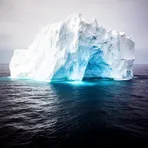
iceberg
 57
1.7
57
1.7

- noun
- /ˈaɪsˌbɜrg/
- To navigate through the icy waters, the captain had to avoid colliding with an iceberg.
- tip of the iceberg
- calving icebergs
- a huge iceberg
Loading YouTube…
Watch on YouTubeSo we've missed the potholes and those big iceberg bottoms that sink our ship.
- So we've missed the potholes and those big iceberg bottoms that sink our ship.
- I've explored the Antarctic, I've scuba dived, you know, on icebergs and down there.
- They've struck the iceberg and go.
- Most people associate sea low rise with melting icebergs for obvious reasons.
- For time immemorial, glaciers have carved icebergs and icebergs have gone out to to sea.
- And it's a, you know, it's, it's the part of the iceberg that you don't see.
- And he found this little group that was clumped up on top of this iceberg.
Examples
-
It's actually just a standard water iceberg that we see in the outer parts of the solar system.
-
Suddenly he shouts: "Iceberg, dead ahead!" only seconds before the ship strikes the huge iceberg.
Academic text (2009) -
The Titanic struck an iceberg and sank.
-
The big white houses were like partially submerged icebergs in the distance.
Fiction book (1998) -
The Titanic struck an iceberg and sank, leading to a major maritime disaster.
-
The fog cleared, revealing the towering icebergs floating silently in the ocean.
Synonyms
 10
7.4
10
7.4
A large piece of ice that floats in the sea after breaking from a glacier


 1
9.9
1
9.9
A small floating piece of ice that can damage ships

A small floating iceberg that comes from a glacier
Compounds
 3
1.2
3
1.2
A pale green lettuce with crisp, tightly packed leaves forming a firm round head
How Big

Surface Forms
Morphology
Etymology
Iceberg comes from the Dutch word ijsberg, made of ice and berg meaning 'mountain'. So it originally meant an 'ice mountain' floating at sea, which fits because most of an iceberg is under the water and only a small top is visible.