

ice pack
 1
4.1
1
4.1

- noun
- /aɪs pæk/
- -Chart a course up to the ice pack.
- Antarctic ice pack
Examples
-
Waves entering the ice pack fracture ice floes into relatively uniform patterns in a band from a few to over 100 km wide, defining the front.
Academic text (1997) -
In the fall, spotted seals move southward with the advancing ice pack, remaining close to the fringe (Burns et al. 6).
Academic text (1997) -
He's headed up into the ice pack.
-
They've got tunnels running through the ice pack.
-
If someone here can provide a means to do it, I can post an additional image whereby we think that we can see the Antarctic ice pack on this date.
Blog text (9) -
They have used a Lunar Orbiter 1 image of the Earth for climate studies, basically a snapshot frozen in time that shows the edge of the Antarctic ice pack on August 23, 1966.
Blog text (9) -
In fact, sea levels have already been forecast to rise by 2-3 meters by the end of this century due mainly to Arctic and high-altitude warming, melting glaciers, frozen tundra, and ice packs.
Blog text (25) -
The research team studied the effects of climate change on the Antarctic ice pack during their expedition.
-
As summer approaches, the Arctic ice pack begins to melt, threatening the habitats of polar wildlife.
-
The thickness of the Greenland ice pack is crucial for scientists tracking global sea level rise.
Synonyms
 3
4.7
3
4.7
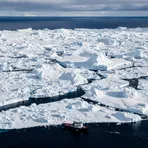
A large flat area of floating ice on the sea
 2
6.7
2
6.7
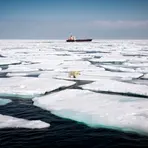
A large area of floating ice pushed together by wind and sea
 1
3.3
1
3.3
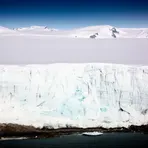
A large area of ice that forms part of a glacier or ice sheet
Large pieces of ice that float on the open sea
How Large

Surface Forms
Morphology
The noun is directly and compositionally built from 'ice' (frozen water) + 'pack' (a bundle or mass), so a B1 learner who knows both constituents can infer a grouped mass of ice pressed together. This compound follows common English noun + noun composition patterns and similar concepts exist cross-linguistically, making the meaning readily recoverable from its parts.
Etymology
Ice pack comes from the image of pieces of ice pressed together like a pack of things stuck side by side on the sea. That's why ice pack means 'a large area of floating ice' that can block ships.