

ice field
 3
4.7
3
4.7

- noun
- /aɪs fiːld/
- UK
- During our expedition, we had to navigate safely across the treacherous ice field to reach the research station.
- a huge ice field
- a vast ice field
- a large ice field
Examples
-
We traverse back across the ice field to a place approximately above the rail road tunnel window.
-
The men cried out that they must return to Iceland, and they must row quickly, for ice floes were breaking off the huge ice field and beginning to surround the longboat.
Fiction book (1994) -
It's a clear sea, and our track takes us quite a bit south of the reported ice field.
-
We go all the way up and come out next to the highest visible ice field.
-
Just as suddenly, not one day west of the Faeroes, a huge ice field moved down from the north and directly into their path.
Fiction book (1994) -
I try to gain a little ground to stop briefly and pan my helmet cam over the dirty ice field.
Fiction book (1997) -
Dirty water, warm even, it seems, rather unnatural in comparison to the great ice field half a mile farther north.
Fiction book (1997) -
Three suns glare down on a huge vista, an ice field, the coldest habitable place in the solar system.
Fiction book (1991) -
But on the slowly flowing ice fields of Antarctica, where other rocks are scarce, meteorites are ripe for the plucking.
Academic text (2003) -
The north lagoon: red ducks glide ahead of us, always faster and more disordered, as if stunned, over the ice field among the isles.
Fiction book (1997)
Synonyms
 2
6.7
2
6.7
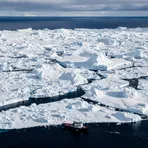
A large area of floating ice pushed together by wind and sea
 1
4.1
1
4.1
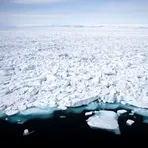
A large area of floating ice pressed together in polar seas
How Big

Surface Forms
Morphology
The meaning 'a large expanse of ice' is directly derivable from combining 'ice' (frozen water) with 'field' (an open area or expanse), following a common noun+noun compounding pattern in English. The use of 'field' to mean a broad area and similar compounds in other languages make the sense readily inferable to a B1 learner who knows both constituents.
Etymology
Ice field comes from sailors and explorers who saw wide, flat areas of ice on the sea and compared them to a land field. So, the phrase means 'a large, flat area of ice on the sea'.