
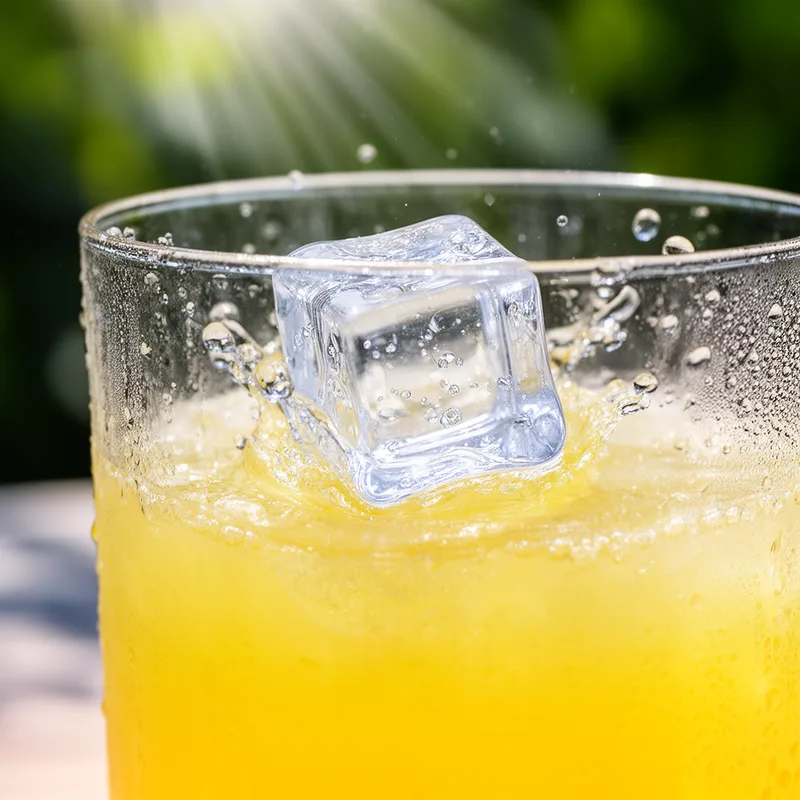
ice cube
 34
1.0
34
1.0

- noun
- /aɪs kjuːb/
- Take some ice cubes and pop them into your glasses.
- ice cube tray
- glass with ice cubes
- put ice cubes
Loading YouTube…
Watch on YouTubeSo if you hear typing or ice cubes, that's that.
- So if you hear typing or ice cubes, that's that.
- I'm currently wearing a vest lined with ice cubes, and I'm talking into my hand.
- It's made in New York, Looks like a little ice cube.
Examples
-
Her hand shook so hard that the ice cubes rattled against the side of the glass.
Fiction book (1990) -
It's a little champagne with a big ice cube and a little soda water.
-
Because the water coming off that ice cube is cold.
-
Each time it does, add an ice cube to reduce the temperature.
Academic text (1993) -
This glass has ice cubes in it.
-
I sat there, with the ice cubes in my drink melting away.
Fiction book (1994) -
I want my cold Coke with ice cubes now and a little piece of lime.
-
After dinner, my daughter served ginger ale and dropped two ice cubes into my wife's drink.
Fiction book (1994) -
To keep my drink cold, I added a few ice cubes to the glass.
-
The bartender placed several ice cubes into the cocktail shaker to chill the mixture.
How Big
57
1.7
 34
1.0
34
1.0
Surface Forms
Morphology
The meaning 'a small cube-shaped piece of ice' is directly and transparently derived from combining 'ice' (frozen water) with 'cube' (a six-sided solid), so a learner who knows both words can infer the compound's referent. This noun–noun compounding and the idea of shaped pieces of ice are cross-linguistically common, making the expression immediately understandable to a B1 learner.
Etymology
Ice cube comes from the simple idea of a small, square piece of ice made in a cube shape. People started making these small squares in trays so they fit in glasses and cool drinks without making them too watery, so the name now means 'a small piece of ice used to cool a drink'.