
ibeji
- noun
- Literature
- For example, the well-known Yoruba twin sculptures called ibeji were categorized according to regional variations in form.
- ibeji figures
- twin ibeji
- carved ibeji
Examples
-
Sophie's favorite remains a Yoruba ibeji twin figure (Fig. 8) collected by her husband in Nigeria in 1958.
Academic text (2003) -
Specifically, by identifying particular features (scarification marks, hair treatment, position of arms, etc.), ibeji sculptures could be compared with more recent carvings for attribution and stylistic changes.
Academic text (2001) -
A small female figure, which looks to be a painted ibeji image, is positioned at the rear, facing outward.
Academic text (2002) -
Some ibeji figures that have been collected have cryptic incised patterns on the bottom of the base.
Academic text (2000) -
To assume that one ibeji was fake because it didn't "look right" would have been a false conclusion.
Academic text (2003) -
PHOTO: Taiwo of Ile Olore Ode with her ibeji, carved by Areogun.
Academic text (1994) -
The wide-open eyes, calm, serious expressions, and upright postures of these unusually large ere ibeji communicate spiritual alertness.
Academic text (2003) -
Both of the museum's well-worn Yoruba ere ibeji are similar in form, style, surface wear, and patination (Fig. 21).
Academic text (2000) -
The couple displayed a beautifully carved ibeji to honor their late twins during the ceremony.
-
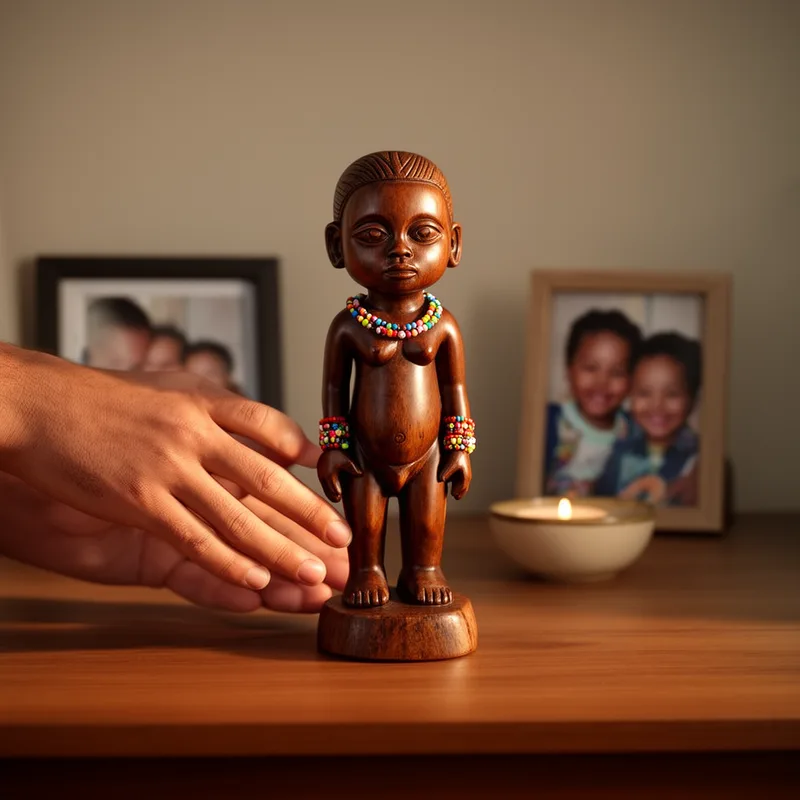
In Yoruba culture, an ibeji figure is often used in rituals to provide protection for twins.
Surface Forms
Etymology
Ibeji comes from the Yoruba word for 'twins' and is used for a carved wooden figure or pair of figures made to honour, protect, or remember a twin. So the name ibeji directly links the object to the idea of twins and their care.

