
hypopnea
- noun
- /ˌhaɪpəˈniːə/
- Specialized
- Obstructive sleep apnea is diagnosed by the presence of at least five obstructive apneas, hypopneas, or both per hour while the patient is sleeping.
- hypopnea index
- obstructive hypopnea
Examples
-
For example, in a population study, Young et al. found that 24% of men and 9% of women had an apnea-hypopnea index (AHI) of 5 or more events per hour.
Academic text (1999) -
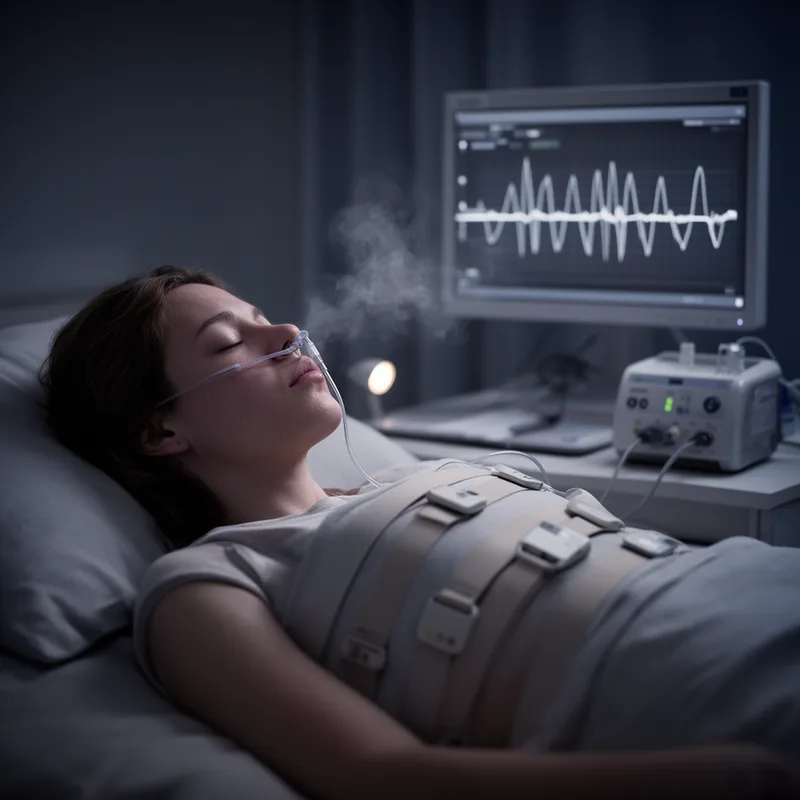
During the sleep study, the patient experienced several episodes of hypopnea, indicating shallow breathing.
-
Significant apneas and hypopneas were present.
Academic text (1999) -
The apnea-hypopnea index was 16.7 events per hour.
Academic text (1999) -
The apnea-hypopnea index was 48.6 events per hour.
Academic text (1999) -
Hypopnea can occur when airflow is impaired but not completely obstructed.
Academic text (1999) -
Subjects each displayed an apnea/hypopnea index of fewer than five episodes per hour and had a history of nightly loud snoring.
Academic text (1996) -
The polysomnogram showed an apnea/hypopnea index of 1.5 (less than 5 is considered normal and not consistent with OSA).
Blog text (18) -
Among children, clinically significant obstructive hypopnea with partial upper airway obstruction is more common than obstructive sleep apnea with complete obstruction.
Academic text (1999) -
Our results were consistent with those reported from in-house polysomnogram sleep studies; 71% of our patients had an apnea-hypopnea index (AHI) of 15 or higher, and 93% had an AHI of at least 5.
Academic text (1999)
Antonyms



- Specialized
Breathing that is deeper and faster than normal, often after exercise or during illness
How Deep
 2
6.8
2
6.8

- Specialized
- Specialized
- Specialized
- Specialized
24
7.1
Surface Forms
Morphology
hypopnea = pnea (opaque) = hypo + pnea
The term is built from the medical prefix 'hypo-' and the bound combining form '-pnea' meaning 'breathing', but the components are not transparent to ordinary learners.
Etymology
The word hypopnea comes from Greek parts hypo- meaning 'under' and -pnea meaning 'breathing', the same -pnea you see in apnea. So it means 'under-breathing', breathing that is too slow or too shallow, which is why doctors use it for reduced breathing during sleep.