
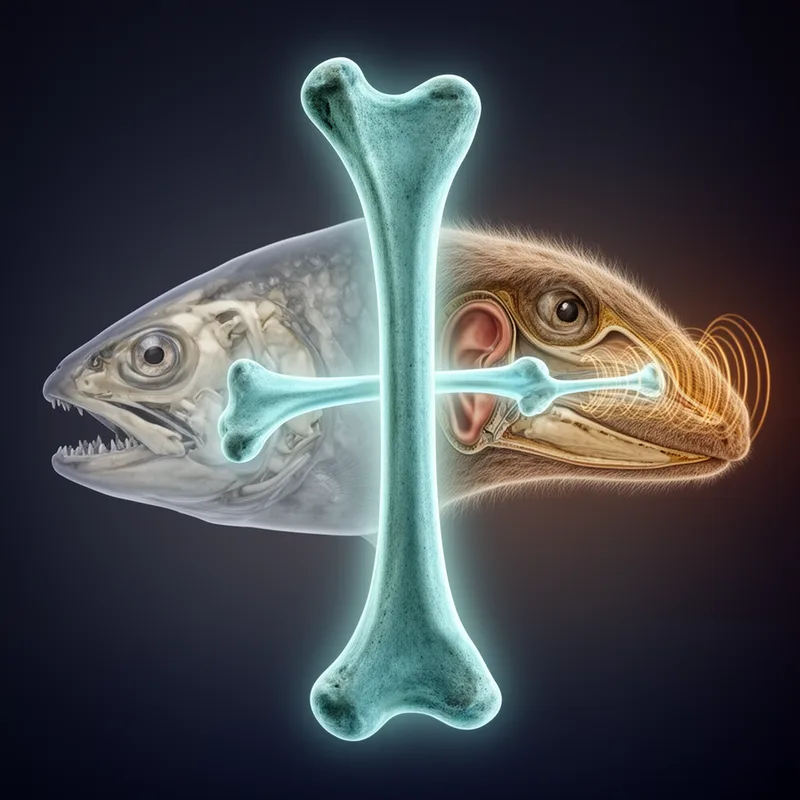
hyomandibula
- noun
- /ˌhaɪoʊˈmændɪbjuːlə/
- Specialized
- The hyomandibula is a crucial bone in fish that supports the jaw during feeding.
Examples
-
However, in all tetrapods, the hyomandibula's role in feeding and ventilation became obsolete.
Academic text (2003) -
It appears that the hyomandibula then served as a bony link connecting the brain case and the cheeks, a partial retention of its original function in fish.
Academic text (2003) -
Their jaws are attached to the brain case mainly by the hyomandibula, and palatoquadrate connections 1 and 3 are replaced by ligaments.
Academic text (2003) -
It is conceivable that the hyomandibula played a role in buccal pumping in the earliest tetrapods.
Academic text (2003) -
Posteriorly, the hyomandibula is connected to the otic capsule (the cranioquadrate passage).
Academic text (2003) -
Meckel's cartilage attaches at the posterior portion of the palatoquadrate, next to the anterior attachment of the hyomandibula.
Academic text (2003) -
In these jawed vertebrates (gnathostomes), the hyomandibula played a dual role in feeding and gill ventilation.
Academic text (2003) -
As tetrapods evolved, the hyomandibula transformed to assist in sound transmission in the middle ear.
-
In early vertebrates, the hyomandibula played an important role in both jaw support and respiration.
Synonyms
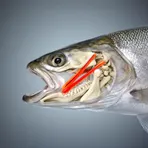
A bone or cartilage in fish that connects the jaw to the skull
Surface Forms
Morphology
Etymology
Hyomandibula comes from two parts, hyo- (from a word for the hyoid or throat, 'throat') and -mandibula (from Latin for 'jaw', 'jaw'). So it names a bone that links the throat area to the jaw, which is why in fish it supports the jaw and in early land animals it later became part of the ear to help pass sound.

