

hyoid
 1
9.9
1
9.9

- adjective
- /ˈhaɪɔɪd/
- Specialized
- The styloid process is a bony outgrowth of the temporal bone that extends, by means of the styloid ligament, toward the lesser cornu of the hyoid bone.
- hyoid bone
Examples
-
In this anatomy class, we learned how the hyoid muscle plays a crucial role in swallowing.
-
The infrahyoid and suprahyoid muscles are partially dissected off to enable the advancement of the hyoid complex.
Academic text (1999) -
Results: Radiation-therapy patients in this study had greater hyoid displacement than did surgery patients.
Academic text (2011) -
The primordial deep layer of muscle from the hyoid arch gives rise to muscles that control the movements of the nose, lips, and around the eyes.
Academic text (2003) -
The curvature change influenced the coordinates of the hyoid bone under the coordinate systems based on C2-C4 and C2-C5.
Academic text (2011) -
The rationale for altering the hyoid position in the treatment of tongue base obstruction is that anatomically, the hyoid complex is an integral part of the hypopharynx.
Academic text (1999) -
The surgeon carefully examined the hyoid bone to assess any damage during the procedure.
-
Understanding the function of the hyoid is essential for studying the mechanics of speech.
Compounds
How Low

Surface Forms
Morphology
hyoid = hyo + oid
Formed from a specialized Greek combining form 'hyo-' plus the scientific suffix '-oid'; the components are technical and not interpretable by an average B1 learner to yield the anatomical meaning.
Etymology
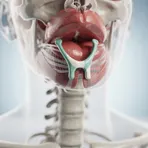
Hyoid comes from Greek parts hyo- and -oid where -oid means 'shaped like'. A helpful way to remember is to think of the small 'U-shaped' bone under the tongue, so hyoid describes things relating to that bone and its role in speech and swallowing.