
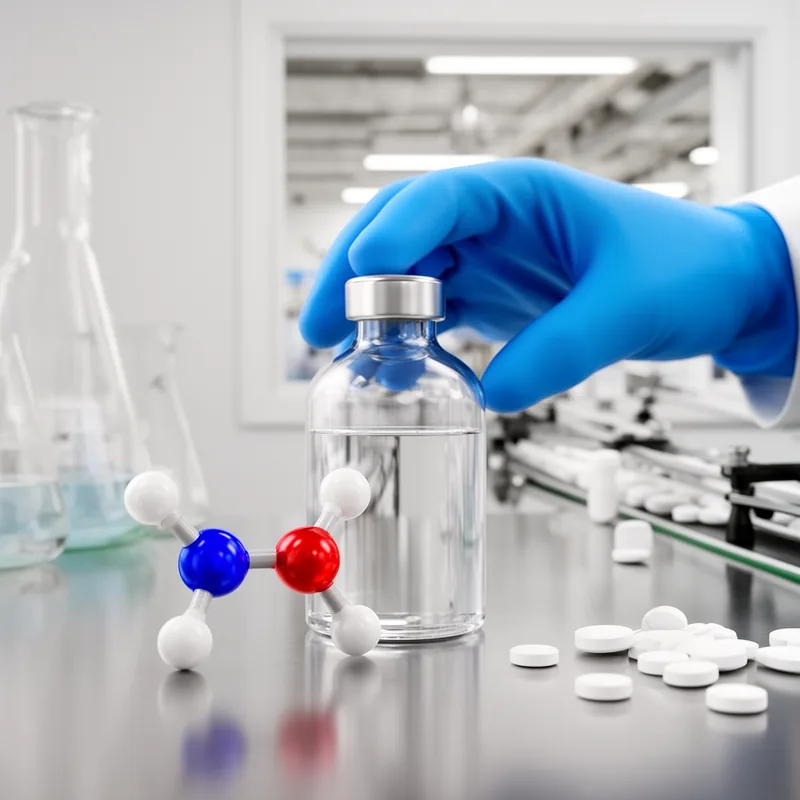
hydroxylamine
- noun
- /haɪˈdrɒksɪlˌeɪmiːn/
- Specialized
- Hydroxylamine is commonly used as a reducing agent in chemical reactions.
Examples
-
Under aerobic conditions, hydroxylamine is both oxidized to nitrite and nitrous oxide.
Academic text (2008) -
Mobile phase A was a mixture of 25 mM 2,6-pyridinedicarboxylic acid, 2 mM hydroxylamine hydrochloride, and 2 mM ascorbic acid prepared in a 50 mM sodium acetate buffer (pH 5) solution.
Academic text (2018) -
As discussed in the results and discussion, 2 mM hydroxylamine hydrochloride and 2 mM ascorbic acid are used to stabilize the oxidation states of plutonium.
Academic text (2018) -
There are two reaction mechanisms for ketone ammoximation with H2O2 over the TS-1 catalyst, i.e., hydroxylamine and imine mechanisms.
Academic text (2018) -
The laboratory used hydroxylamine to convert the compound into a more stable form.
-
Researchers added hydroxylamine to the solution to prevent unwanted oxidation.
Surface Forms
Morphology
Etymology
Hydroxylamine comes from the parts hydroxyl and amine. Hydroxyl points to an 'OH' part, like in water, and amine comes from 'ammonia', a simple nitrogen compound. So hydroxylamine is a small chemical with both an 'OH' part and an 'NH2' part, which is why it is used to change other chemicals in labs and factories.

