
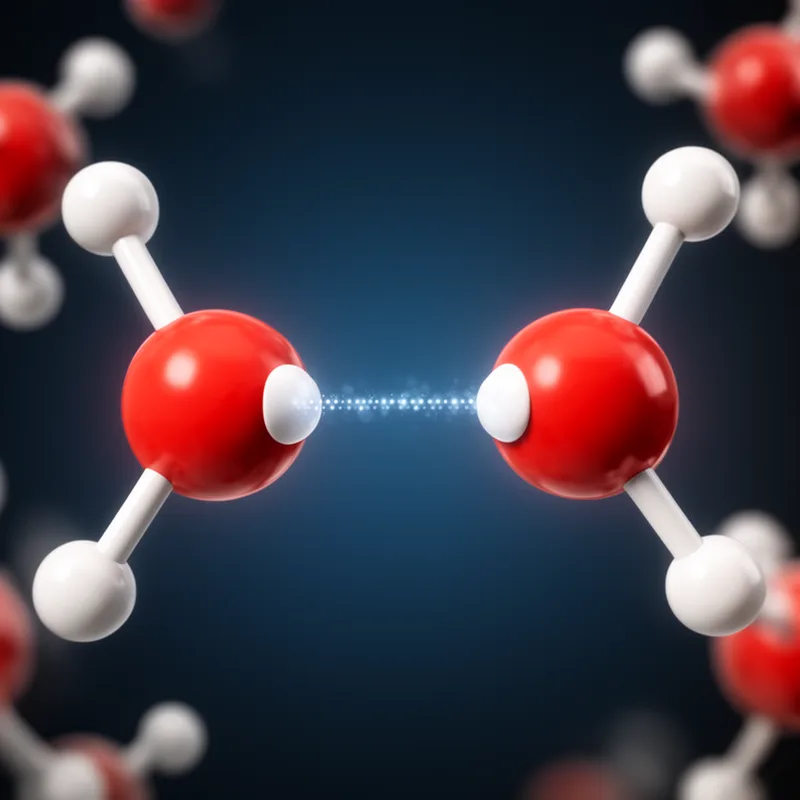
hydrogen bond
 1
4.1
1
4.1

- noun
- /ˈhaɪdrədʒən bɑnd/
- Specialized
- Previous methods have not been able to directly probe these hydrogen bonds.
- breaking hydrogen bonds
- forming hydrogen bonds
- four hydrogen bonds
Loading YouTube…
Watch on YouTubeRemember that the water has hydrogen bonds, but the, but the sugar does too.
- Remember that the water has hydrogen bonds, but the, but the sugar does too.
- So A sticks to TG sticks to C and they're held together by hydrogen bonds.
Examples
-
In liquid water, each molecule often forms four hydrogen bonds.
Academic text (2007) -
Water's hydrogen bonds are responsible for its high boiling point compared to other similar molecules.
-
In the liquid, the network extends only locally, and the hydrogen bonds continually break and re-form.
Academic text (2007) -
If ice is compressed, the hydrogen bonds shorten and become more like those in the liquid.
Academic text (2007) -
Stable hydrogen bonds also lead to the strong cohesive forces underlying the unusually high surface tension of water.
Academic text (2007) -
Hydrogen bonds will form between amides and carbonyls at about every fourth amino acid residue.
Fiction book (2000) -
Several research groups have used 2D spectra of liquid water to probe the time scales on which hydrogen bonds form and break and to explore the connectivity of different hydrogen-bonded clusters.
Academic text (2012) -
In liquid water, each molecule often forms hydrogen bonds that stabilize its structure.
-
The strength of a protein's structure can be influenced by the hydrogen bonds between its amino acid chains.
How Strong
- Specialized
1
3.8

- Specialized

 1
3.7
1
3.7
- Specialized
1
4.1
- Specialized
Surface Forms
Morphology
The term is compositionally built from 'hydrogen' + 'bond', so a learner who knows those words can infer it denotes a type of bond involving hydrogen (e.g., holding water molecules together). While full technical details (electrostatic vs. covalent character) require chemistry knowledge, the basic meaning is directly derivable and cross-linguistically expressed in similar noun‑noun compounds.
Etymology
The noun hydrogen bond is called that because a small hydrogen atom acts like a tiny 'bridge' or 'glue' between two other atoms, forming a bond that is weaker than a strong chemical link. So a hydrogen bond is a weak link that still helps 'hold things together', for example in water and DNA.