
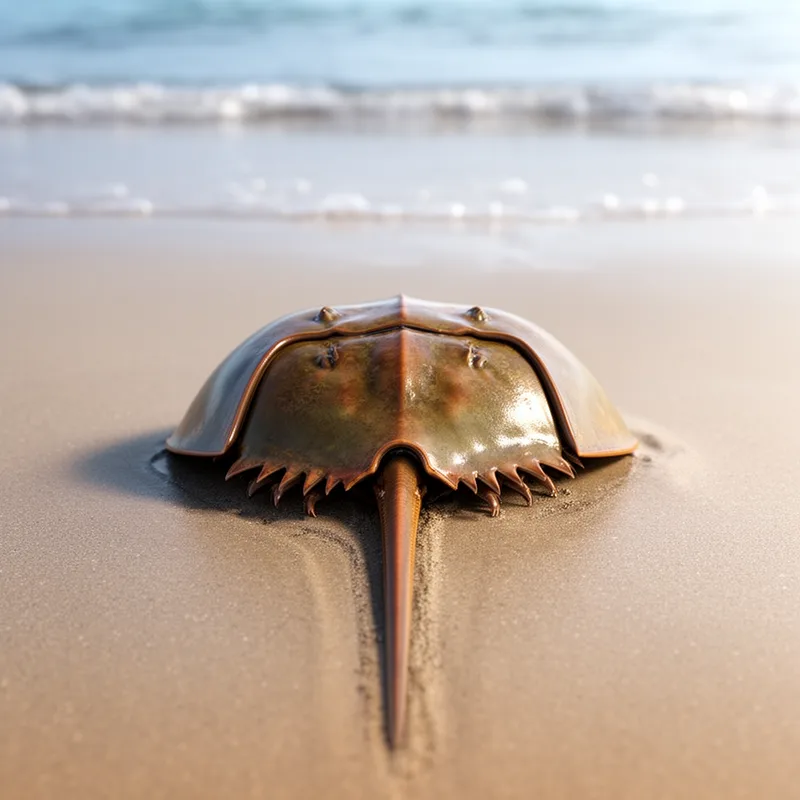
horseshoe crab
 2
7.8
2
7.8

- noun
- /ˈhɔrsˌʃuː kræb/
- Specialized
- Scientists study the horseshoe crab's unique blood, which is used to test for bacterial contamination.
- horseshoe crab eggs
Examples
-
In spring, many people visit the beach to observe horseshoe crabs laying their eggs in the sand.
-
The horseshoe crab is often seen along the Atlantic coast, particularly during the spawning season.
-
Children were invited to make horseshoe crab puppets and fish prints.
Blog text (1) -
Blue crabs and horseshoe crabs were an incidental part of the catch.
Academic text (1990) -
Mollusks often latch onto the underside of the horseshoe crab.
Academic text (2002) -
The horseshoe crab's hard shell is home to a bevy of invertebrates.
Academic text (2002) -
The causes of declines in bay scallops, horseshoe crabs, and worms are unknown.
Academic text (1990) -
Though the water was murky, ZL spotted this baby horseshoe crab drifting in the water.
Blog text (8) -
Young horseshoe crabs encounter the same problem but deal with it through rapid growth, frequent moltings, and burrowing.
Academic text (2002) -
There were also plenty of horseshoe crabs, butterfly rays, Atlantic spadefish, and flounder.
Blog text (9)
Synonyms

 1
9.9
1
9.9
A sea animal with a hard shell, a kind of horseshoe crab

A large sea animal with a hard horseshoe-shaped shell and a long pointed tail

A large sea animal like a crab with a hard domed shell and pointed tail
Surface Forms
Morphology
The compound is compositionally built from 'horseshoe' (U-shaped object) + 'crab' (marine crustacean), so a B1 learner who knows both words will infer a crab-like marine animal with a horseshoe-shaped shell. Although biologically it is not a true crab, the shape-based, literal combination is salient and cross-linguistically transparent, making the basic meaning derivable from the constituents.
Etymology
Horseshoe crab gets its name from its hard, curved shell that looks like a metal 'horseshoe' and from its general look like a real 'crab'. So the name gives an easy picture of its shape and why people called it a 'crab' even though it is a very old sea animal and not a true crab.