

horse-chestnut family
- noun
- Specialized
- She studied the flowering patterns of several members of the horse-chestnut family for her botany thesis.
Examples
-
The glossy seeds from trees in the horse-chestnut family are commonly known as conkers.
-
The horse-chestnut family includes both North American and Eurasian species of trees.
-
The horse-chestnut family includes several species of trees.
-
Many trees in the horse-chestnut family bloom in the spring.
-
The horse-chestnut family is often admired for its beautiful, showy flowers during the spring season.
-
Several species within the horse-chestnut family are known for their unique nutlike seeds found in leathery capsules.
-
In her research, she focused on the diverse characteristics of trees belonging to the horse-chestnut family.
Synonyms
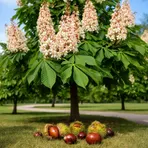
A family of trees like horse-chestnuts with showy flowers and hard inedible nuts
Surface Forms
Morphology
horse-chestnut + family
The phrase is compositional: 'family' as a scientific grouping plus the plant name 'horse-chestnut' yields 'the taxonomic family that includes horse-chestnuts.' This noun + family pattern is a regular, cross-linguistic way to name biological groups, so a B1 learner who knows the constituents would readily infer the meaning.
Etymology
Horse-chestnut family may come from the well-known tree called the horse-chestnut, which has large shiny seeds that look like chestnuts and were once used around horses or in old horse remedies. So the name points to a group of trees like that horse-chestnut, which helps you remember it means trees with showy flowers and nutlike seeds not for eating.

