

hominid
 2
8.0
2
8.0

- adjective
- /ˈhɒmɪnɪd/
- Specialized
- It's because consciousness is seated in the hominid brain and certain parts of the mammalian brain.
- hominid fossils
- early hominid
- hominid evolution
Loading YouTube…
Watch on YouTubeBut what that meant is love in our, our hominid evolution was distributed in communities, right?
- But what that meant is love in our, our hominid evolution was distributed in communities, right?
Examples
-
Fisher argues that the reshaped pelvic anatomy would lead to hominid females experiencing difficult births and many dying young.
Academic text (1995) -
Since Darwin's day, paleoanthropologists have energetically sought the key to hominid erectness in many different places.
Academic text (2003) -
Graph: The hominid family tree.
Academic text (1999) -
Besides, they started to interbreed with other hominid species such as Neanderthals.
Blog text (19) -
As best we know, the Arctic has been frozen for the entirety of hominid evolution.
Blog text (21) -
Well, it is clear that bipedalism arose quite early in hominid history, even if no one can be certain, in the strictest genealogical sense, that the earliest hominid was an upright biped.
Academic text (2003) -
In 1891, Dutch physician Eugene Dubois found hominid fossils in Trinil, Java, but many scientists were skeptical of his finds.
Academic text (2006) -
The study of early tools gives insight into the hominid behavior and intelligence.
-
Recent discoveries have shed light on the hominid lineage leading directly to modern humans.
-
Researchers are examining the diet of hominid species to understand their survival strategies.
Synonyms
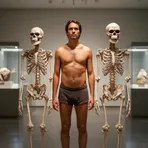
Relating to humans and their early relatives
Surface Forms
Morphology
hominid = human (opaque) = homin + id
The adjective sense is formed the same way as the noun: the combining form 'homin-' with the scientific suffix '-id' yields a technical adjective; the morphological pieces are not familiar standalone English morphemes for most learners.
Etymology
Hominid as an adjective comes from the Latin homo 'human' plus -id 'group', so it means 'related to the human family'. That's why we call features like walking upright or smaller canine teeth hominid traits when they link a fossil to humans.