
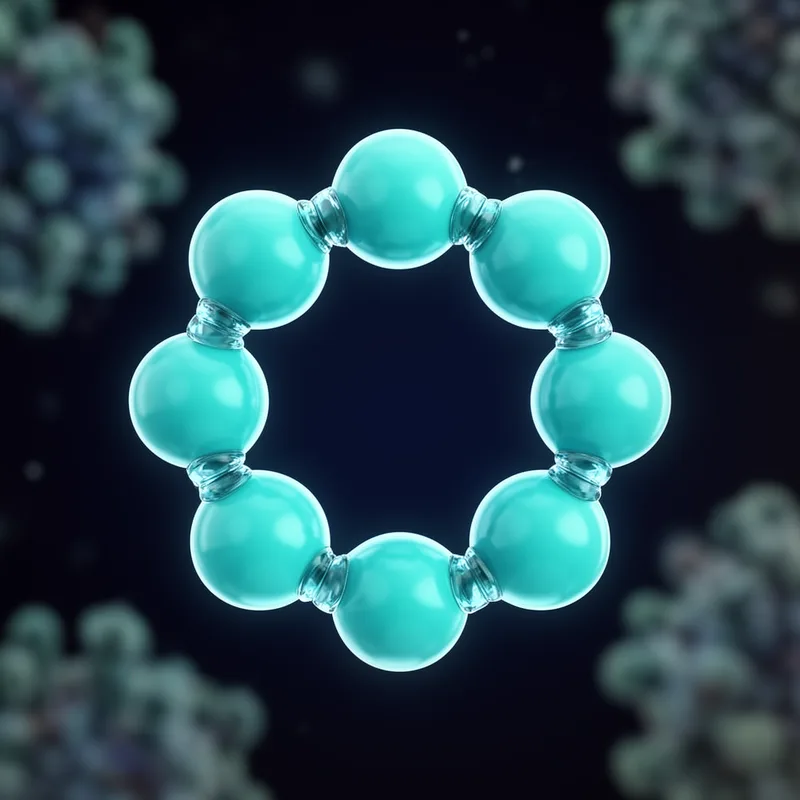
hexameric
- adjective
- /hɛkˈsæmərɪk/
- Specialized
- In the study, researchers found that the hexameric arrangement of the molecules increased the efficiency of the reaction.
Examples
-
As figure 1 shows, the proteins that make up a hexameric or pentameric capsomer, like other proteins, are messy strings of amino acids. Capsomer proteins vary widely from virus to virus.
Academic text (2004) -
The enzyme functions as a hexameric structure, meaning it consists of six identical subunits working together.
-
When capsomers can switch between pentameric and hexameric states at no energy cost (black curve), the minima correspond to Caspar and Klug's predicted sequence.
Academic text (2004) -
Turnip yellow mosaic virus, as shown on the left, has a roughly spherical capsid comprising 12 pentameric capsomers and 20 hexameric capsomers.
Academic text (2004) -
The virus's protein coat is composed of hexameric subunits, providing durability and stability.
Synonyms

A ring in a molecule that has six atoms like benzene
Having a ring of six atoms in its chemical structure
Made of a few similar parts joined together like protein parts
How Many Parts


 1
7.7
1
7.7

- Specialized
- Specialized
- Specialized
- Specialized
- Specialized
- Specialized
Surface Forms
Morphology
Etymology
Hexameric comes from the Greek words hex- meaning 'six' (as in hexagon) and -meric from meros meaning 'part', which you also see in polymer. So, hexameric means 'made of six parts'.