
heterosporous


 1
9.9
- adjective
- /ˌhɛtərəˈspɔrəs/
- Specialized
- This condition actually imparts to homosporous species greater breeding system amplitude than their heterosporous relatives possess.
- heterosporous species
- heterosporous plants
Examples
-
Being homosporous may impose a different set of evolutionary constraints and predispositions on species than being heterosporous does.
Academic text (2002) -
What are the differences between homosporous and heterosporous organisms that may influence interpretations of their genetic systems?
Academic text (2002) -
If this were true, why would only the heterosporous pteridophytes, such as Selaginella and Marsilea, reduce their numbers of chromosomes?
Academic text (2002) -
But these "evolutionary experiments" in the heterosporous way of life, whose ancestors are homosporous, did not result in the extraordinary burst of diversification seen among the seed plants, and they are not the focus of this review.
Academic text (2002) -
The Isotaceae are a small, cosmopolitan family of aquatic, heterosporous pteridophytes that are related to the extant Selaginellaceae and Lycopodiaceae families.
Blog text (27) -
As Walker (1979) states succinctly, "The heterosporous plant, in order to establish polyploidy, must meet very rigorous conditions both in time and space, whereas the homosporous plant has to fulfill much less demanding conditions" (p. 100).
Academic text (2002) -
Finally, as pointed out by Walker (1979), once a polyploid gametophyte has been formed by a homosporous plant, it is much more likely that it will generate a polyploid sporophyte than a heterosporous plant would.
Academic text (2002) -
Unfortunately, developing and testing hypotheses about the genetics and evolution of homosporous pteridophytes has been a difficult enterprise because, although homosporous plants share many structural features with their much-studied heterosporous siblings, the reproductive biology of these two groups is quite different.
Academic text (2002) -
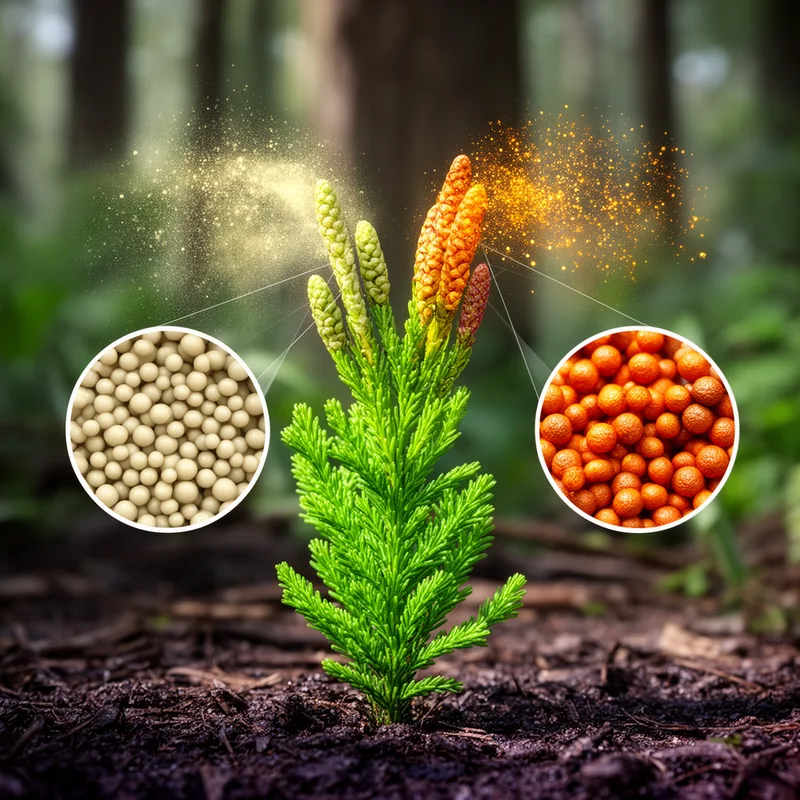
Heterosporous species have unisexual gametophytes: microspores produce exclusively male gametophytes and sperm, while megaspores germinate to initiate only female gametophytes and eggs.
Academic text (2002) -
The interesting feature of the plant is that it is heterosporous, producing both male and female spores.
How Diverse
- Specialized
1
9.9

- Specialized
Surface Forms
Morphology
heterosporous = heterospore (semi-transparent) = hetero + spore + ous
The adjective is formed by the regular addition of '-ous' to the noun 'heterospore', which is a straightforward adjectival derivation.
Etymology
The word heterosporous comes from the parts hetero- meaning 'different' and spore meaning 'tiny seed', as in heterogeneous. So a heterosporous plant makes two different kinds of spores, usually male and female, which is why the name means 'different spores'.