
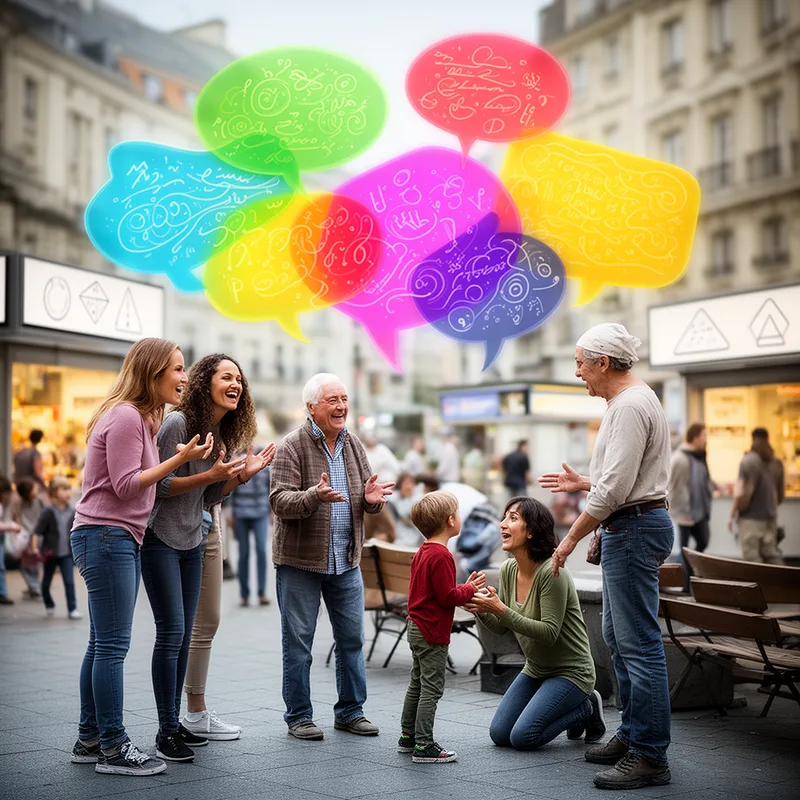
heteroglossia
- noun
- /ˌhɛtəroʊˈɡlɑːsiə/
- Specialized
- In the city, you can hear the heteroglossia of different languages being spoken in shops and cafes.
Examples
-
Heteroglossia allows Momaday to give linguistic and symbolic expression to the erosion of the Native world under the stress of Anglo-American hegemony.
Academic text (2005) -
Bourne proposed to embrace these multiple cultural languages, the heteroglossia of the practical democracy of American streets.
Academic text (2007) -
My face is also my mask, not just a saving and necessary heteroglossia in Bakhtin's sense, but a hetero-physiognomia, a blend of my features and the faces opposite mine.
Academic text (1998) -
Bakhtin's concept of heteroglossia, for example, implies a polyphonic self, a dialogue with internalized others that complicates the concept of the single, unitary response traditionally ascribed to the one who apprehends the work of art.
Academic text (1997) -
The festival celebrated the heteroglossia present in our community by featuring music and food from various cultures.
-
Their discussions reflected the heteroglossia of opinions and dialects, showcasing the rich diversity of their neighborhood.
Synonyms

The use of more than one language in a community, school, or family
Antonyms


How Diverse

Surface Forms
Morphology
heteroglossia = heterogloss (semi-transparent) = hetero + gloss + ia
Formed as 'heterogloss' + '-ia' (a nominalizing suffix); the parts reflect 'different' + 'tongue/language' but the combining forms and the technical sense are unfamiliar to most learners.
Etymology
Heteroglossia comes from Greek parts hetero- meaning 'different' and gloss meaning 'tongue' or 'language', and gloss is the same root as in glossary. So heteroglossia literally means 'different tongues', which helps you remember it is about many languages or dialects mixing and interacting in one community.