

herm
 2
9.9
2
9.9

- noun
- /hɜrm/
- Specialized
 :
herma
:
herma
- No longer mere mantle busts or domesticated herms, his figures take on roles as sacerdotal temple attendants or loyal servants who receive guests.
Examples
-
On the sculpted altar front just behind the garden herm, a female figure on the far right flees while raising her arm.
Academic text (2004) -
They were called herms after Hermes, the god whose organ was being celebrated.
Fiction book (1995) -
Asti Spumante—and was so complimentary about the wreath he wore that Fred feared she was about to follow the bacchante's example and commence to adore the herm.
Fiction book (1995) -
The ancient Greeks often placed a herm at the entrance of their homes as a protective symbol.
-
Visitors to the archaeological site were amazed by the beautifully preserved herms marking the pathways.
-
The museum showcased a collection of herms, each intricately carved with the likeness of Hermes.
Synonyms
 5
9.9
5
9.9
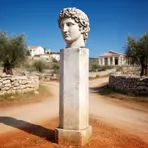
A carved statue or bust on top of a pillar that marks a boundary

 1
9.9
1
9.9
A square stone pillar with a carved head used as a boundary marker in ancient Greece
How Ornate

Surface Forms
Etymology
The word herm comes from the Greek god Hermes, who was seen as a 'messenger' and protector of roads and borders, so people put his carved head on square stone pillars to mark places. So, a herm is a stone pillar with a head used as a 'signpost' or 'boundary' marker.