
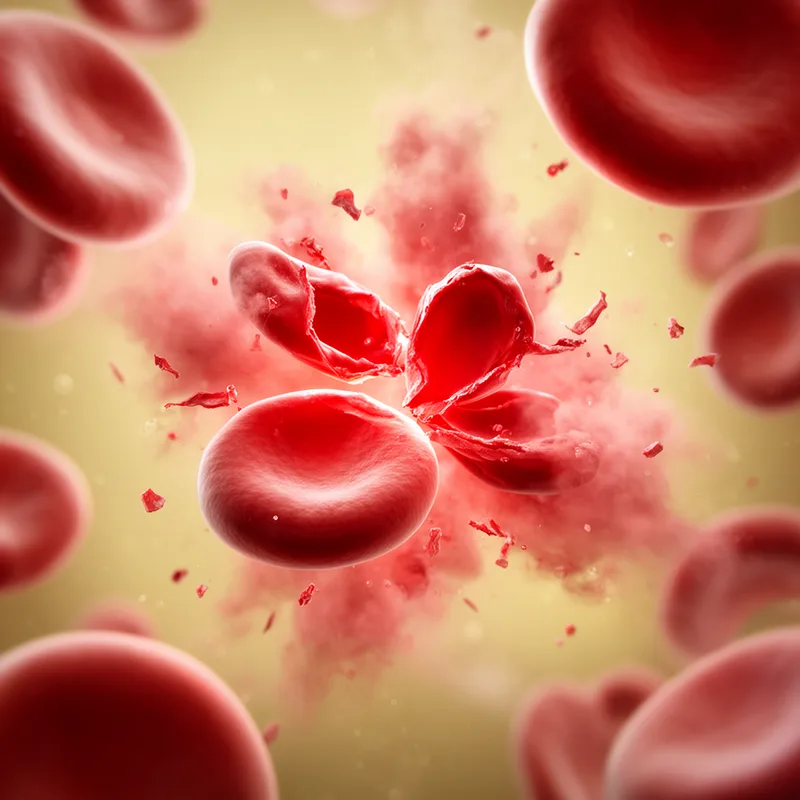
hemolysis
 3
8.8
3
8.8

- noun
- /hɪˈmɑːlɪsɪs/
- Specialized
- Laboratory tests indicated that hemolysis was present, suggesting that the red blood cells were being destroyed at an abnormal rate.
Examples
-
Treatment of hemolytic anemia is governed by the severity of the condition and the ability to address the underlying cause of the hemolysis.
Academic text (2003) -
With genetically determined hemolytic anemia, the treatment focuses on limiting the disease process, which will, when effective, reduce the extent of the hemolysis (see Inherited Anemias in the following section).
Academic text (2003) -
One of the complications of sepsis is the rapid development of anemia caused by hemolysis.
Academic text (2017) -
Blood shows preponderance of acanthocytes indicative of severe hemolysis.
-
When a hemolytic episode is triggered, the degree of hemolysis can be mild or severe, and when the trigger is removed, the episode resolves.
Academic text (2003) -
These antibodies may have serious consequences, such as hemolysis, organ failure, and even death, if the patient is transfused with RBCs expressing cognate antigens.
Academic text (2013) -
The doctor explained that hemolysis can occur after a blood transfusion if the blood types are not matched properly.
-
In patients with certain diseases, hemolysis leads to the release of hemoglobin into the blood, which can cause various complications.
Synonyms

Red blood cells break open and let the red part of blood flow into the fluid around them
How Severe
- Specialized
2
5.4

- Specialized
3
8.8
Surface Forms
Morphology
Etymology
Hemolysis breaks into hemo- meaning 'blood' and -lysis meaning 'break' or 'loosen'. So, hemolysis is the 'breaking' of red blood cells, which lets their contents out into the fluid around them.