
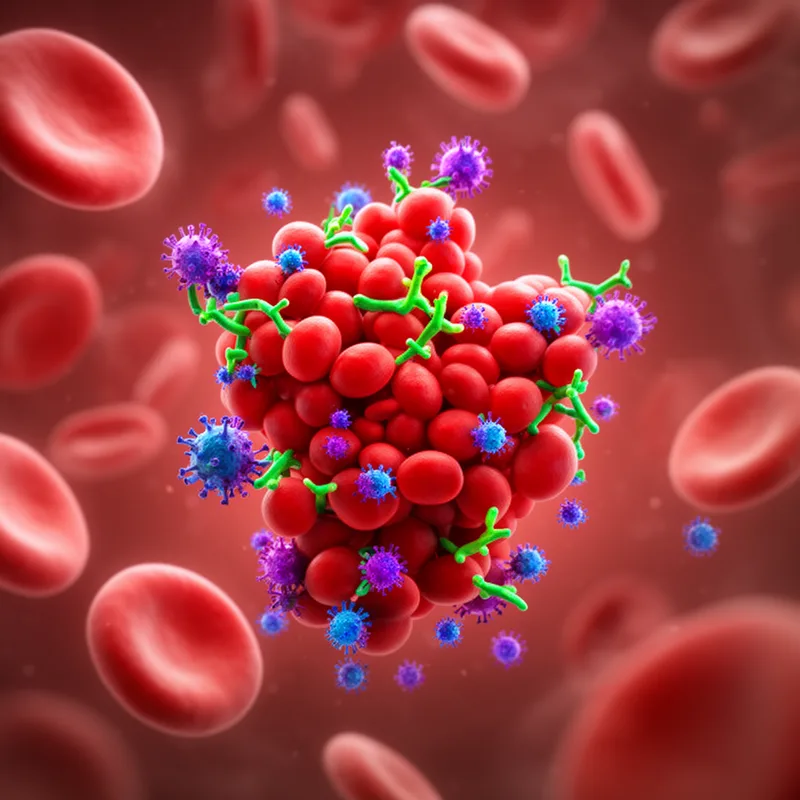
hemagglutination
- noun
- /ˌhiːməˌɡluːtɪˈneɪʃən/
- Specialized
- Hemagglutination tests were performed to define blood types.
- hemagglutination inhibition
- hemagglutination test
Examples
-
Confirmation of the virus was done by hemagglutination inhibition (HI) assay using mono-specific serum against H9 AIV (Stephan and Charles, 2008).
Academic text (2015) -
Hemagglutination inhibition (HI) and microneutralization (MN) tests for H5N1-specific antibodies were negative in samples taken during the acute phase of illness (online Technical Appendix).
Academic text (2013) -
IFAT, indirect immunofluorescence antibody test; IHA, indirect hemagglutination antibody test.
Academic text (2013) -
Sample days are days since disease onset in the index case-patient. HHI, horse hemagglutination inhibition; MN, microneutralization; ND, not done.
Academic text (2013) -
NAb titers were defined as the reciprocal of the highest serum dilution at which 50% of wells were protected. Hemagglutination Inhibition Assay.
Academic text (2014) -
The RHDV-N11 variant differs antigenically from classic RHDV, as determined by dot-blot analyses using monoclonal antibodies and hemagglutination analysis.
Academic text (2012) -
Animals were inoculated by the intranasal route with 106.5 egg-infective dose 50/0.1 mL of the selected viruses; HI, hemagglutination inhibition.
Academic text (2015) -
All samples were tested by hemagglutination inhibition and microneutralization assay as described (5, 6) by using the MRV1-HB-A isolated strains as antigen.
Academic text (2013) -
The laboratory used hemagglutination to determine whether the blood samples contained the virus.
-
Doctors often rely on hemagglutination tests to diagnose certain infections in patients.
Synonyms
Small cells or particles sticking together to form clumps in a liquid like blood
Antonyms


Surface Forms
Morphology
hemagglutination = hemagglutinate (opaque) = hema + agglutin + ation
The noun is a regular derivation from the verb 'hemagglutinate' using the productive suffix '-ation'.
Etymology
Hemagglutination breaks into hema- meaning 'blood', as in hemoglobin, and agglutin- meaning 'to glue', like 'glue'. So hemagglutination is literally 'blood-gluing', which is why it means red blood cells clumping together.