
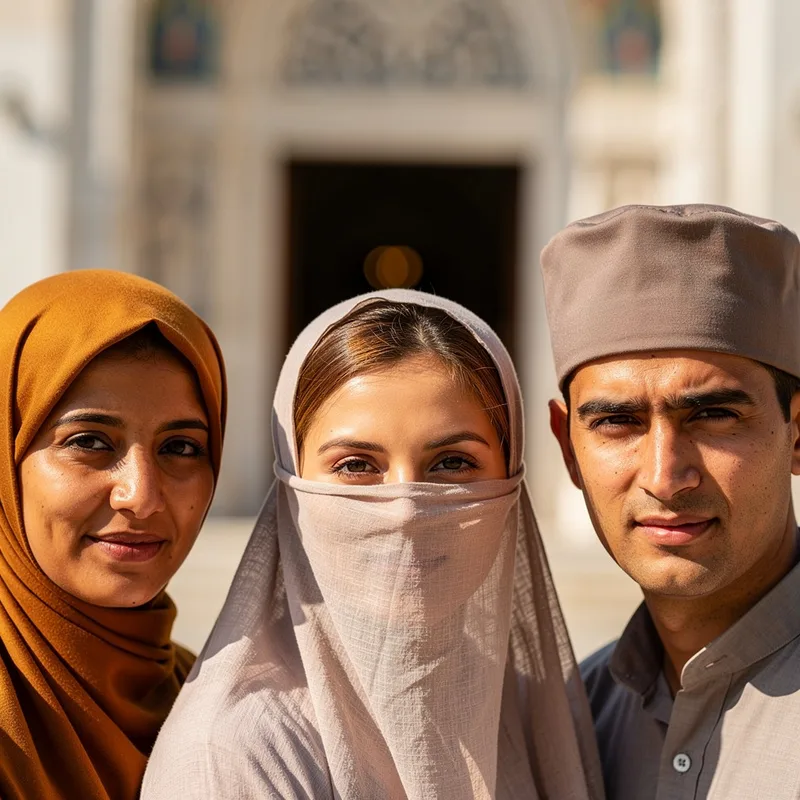
head covering
 2
2.2
2
2.2

- noun
- /hɛd ˈkʌvərɪŋ/
- In the early and middle twentieth century, these long, sparsely decorated, indigo-dyed cotton cloth head coverings were worn simply as modesty garments.
- wearing a head covering
- religious head coverings
- women's head covering
Loading YouTube…
Watch on YouTubeAnd also, like I have to say, like when a kid walks by and he has a head covering A kippah and you know, he's Jewish and you call him a baby killer.
- And also, like I have to say, like when a kid walks by and he has a head covering A kippah and you know, he's Jewish and you call him a baby killer.
Examples
-
But these head coverings are very different from the hijab.
Academic text (2006) -
I wear a kippah, a head covering that says to the world, I'm on this team, this is my tribe and I I'm held accountable.
-
In his day, a gentleman rarely stepped out of doors without some sort of head covering, summer or winter.
Fiction book (2001) -
With no head covering and short sleeves, I felt out of place.
Fiction book (1998) -
Remove your head covering.
-
Prior to the revolution in 1979 in Iran, women were prohibited from wearing religious head coverings called chadors as expressions of their faith.
Academic text (2010) -
Arab women living throughout Mauritania and northern Senegal also cover themselves with indigo head coverings (Du Puigaudeau 1970:13).
Academic text (2006) -
In his day, a gentleman rarely stepped out of doors without some sort of head covering, summer or winter.
-
Nancy emerges in a clean, ironed dress, her hair fixed, her head covering neatly pinned.
-
Not much of her hair showed under her stiff white head covering, but what did show was a dark brown color.
Synonyms
 ∞
1.0
∞
1.0
A shaped covering for the head with a brim worn for warmth, protection, or style
 649
1.0
649
1.0
A hard or padded hat that protects the head from injury
 175
1.0
175
1.0
A soft hat that fits the head, often with a small brim
 134
1.0
134
1.0
A long piece of cloth worn around the neck or shoulders to keep warm
 59
3.4
59
3.4
A cloth worn to cover the head and face for religion, ceremony, or privacy
 19
4.1
19
4.1
A hat for women or children tied under the chin that covers the ears and back of the head
 18
5.2
18
5.2
A cloth some Muslim women wear to cover their hair and neck for modesty
 18
5.6
18
5.6
An item worn on the head for ceremonies like weddings
 18
3.6
18
3.6
A piece of hair worn to hide baldness or change hairstyle
 10
2.3
10
2.3
A piece of cloth often worn by women on the head for warmth, to cover hair, or for style
 8
3.7
8
3.7
Items like hats worn on the head for protection, decoration, or ceremony
 4
7.7
4
7.7
A close-fitting cap that covers the head, neck and most of the face, leaving the eyes open
 3
7.6
3
7.6
A small round cap that fits the top of the head and has no brim, often worn for religious reasons
 3
3.1
3
3.1
Items you wear on your head, like hats or helmets
 1
1.0
1
1.0
A hat with a wide brim that protects your face from the sun
 1
1.0
1
1.0
A hat with a wide brim that protects your face and neck from the sun
 1
6.3
1
6.3
A thin cloth worn to partly cover the face, often for religious or cultural reasons
 1
5.8
1
5.8
A strong covering worn on the head to protect it


 1
4.1
1
4.1
A long coat with a hood that you pull over your head
 1
2.7
1
2.7
A hard plastic or metal hat that protects the head on construction sites

A cloth worn on the head for cultural, religious, or protective reasons

A close-fitting hat that covers the head and neck, leaving only the eyes or mouth exposed

A lightweight hat with a wide brim that protects the head and neck from the sun
How Protective

Surface Forms
Morphology
The meaning is directly and transparently derived from combining 'head' (the body part) with 'covering' (a layer placed over something); a B1 learner who knows both words can infer it denotes an item worn to cover the head. This is a simple compositional noun phrase following common cross-linguistic patterns for compounds/nominal phrases, so the sense is immediately comprehensible.
Etymology
Head covering names any cloth or hat that covers the head and sometimes the face. Imagine wrapping a scarf over your head to show respect in a temple or to keep warm; that picture of covering the head is why the term means 'a garment worn to cover the head'.