
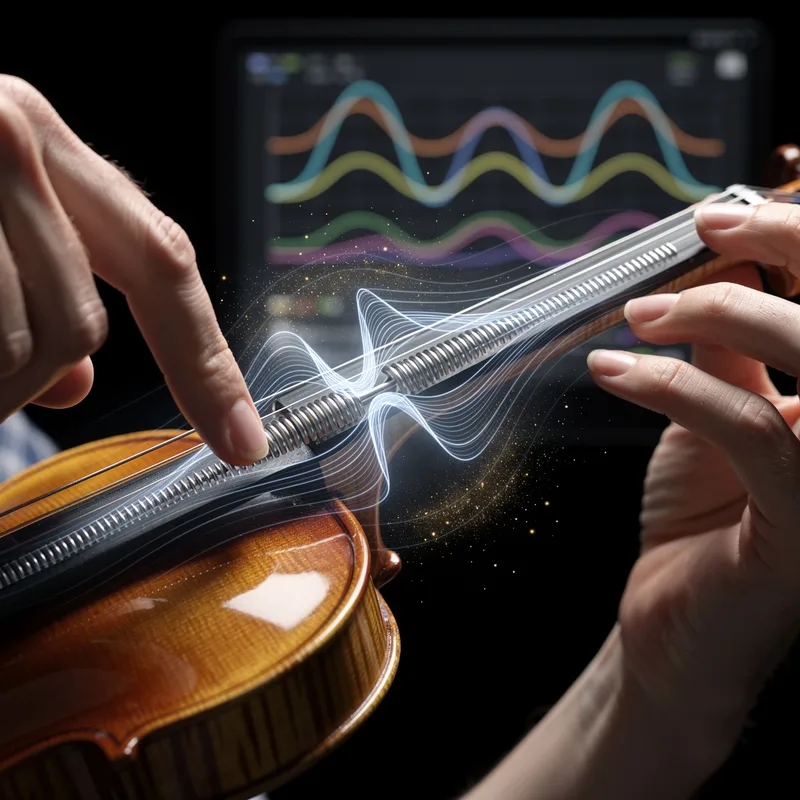
harmonic
 3
6.7
3
6.7

- noun
- /hɑːrˈmɒnɪk/
- Specialized
- In this composition, the harmonic overtones blend beautifully to enhance the melody.
- second harmonic
Loading YouTube…
Watch on YouTubeThey make those side band harmonics that our ears interpret as high end.
- They make those side band harmonics that our ears interpret as high end.
- And it is really hard to design one that can be messed up by a fatal harmonic.
Examples
-
The second harmonic produces a tone that is an octave higher than the fundamental frequency.
-
Indeed, most pulsating stars are observed to pulsate in the fundamental or in the first harmonic, and some stars pulsate in both.
Academic text (1991) -
We saw that example with the harmonic series, right?
-
And remember, we already know that the harmonic series diverges.
-
Middle C might also arise as the harmonic of a longer pipe with a fundamental of lower pitch.
Academic text (1991) -
From a Catholic church somewhere beyond the garden comes the sound of robust, a cappella harmonic singing.
Academic text (2010) -
The relation was pronounced between the even and odd harmonics in the range of the fourth to the tenth harmonic, where the odd harmonics were approximately equal to the even harmonics in magnitude.
Academic text (1990) -
Musicians often tune their instruments to create a rich harmonic sound during performances.
Synonyms
 3
7.4
3
7.4
A higher musical tone that sounds above the main note

A tone inside a sound that helps make an instrument's unique sound

A higher sound made when the main note vibrates a whole number of times
Compounds

- Specialized

 1
6.3
1
6.3
A movement that goes back and forth around a middle point, like a pendulum

- Specialized
1
7.5
An average for rates found by dividing the number of values by the sum of 1 divided by each value


- Specialized
A sequence of numbers where 1 divided by each number increases by the same amount

- Specialized
To break a repeating sound or signal into simple waves like sine and cosine


- Specialized
A repeating back and forth movement where the pull back gets stronger the farther it moves from center
How Pure

Surface Forms
Morphology
harmonic = harmony (semi-transparent) = harmon + ic
Formed from the base concept 'harmony' plus the suffix '-ic', but the technical noun sense 'overtone' is specialized and may not be obvious to general learners.
Etymology
Harmonic comes from the Greek root harmonia, which means 'fitting together' and is the same root as harmony. A harmonic is an extra tone that 'fits' with a main tone, so the origin helps explain why harmonics are tones that match and add to a sound.