
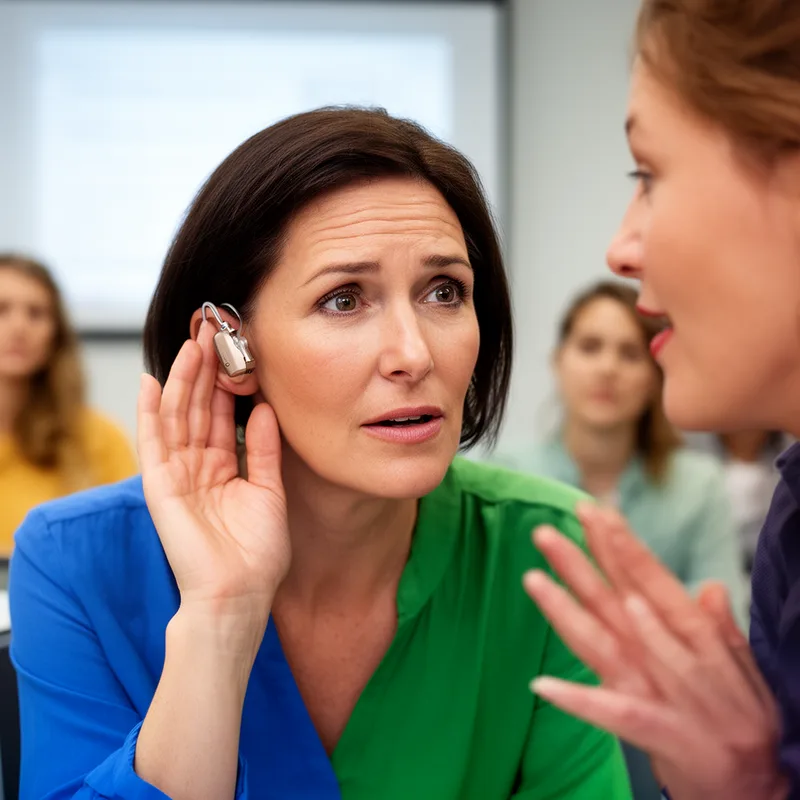
hard-of-hearing


 1
4.2
1
4.2
- adjective
- /hɑrd əv ˈhɪrɪŋ/
- The parents often have considerable negative feelings about the use of sign language and feel a sense of relief that it will not be necessary for their hard-of-hearing children to learn it.
- hard-of-hearing students
- hard-of-hearing or deaf
Examples
-
Research suggests that the academic achievement of deaf and hard-of-hearing (DHH) students is the result of a complex interplay of many factors.
Academic text (2015) -
Those with Type II are born hard-of-hearing with RP and have normal balance (Kimberling & Moller, 1995; R.J.H. Smith et al., 1994).
Academic text (1997) -
Teenagers with Type II grow up as hard-of-hearing or culturally Deaf.
Academic text (1997) -
Many people with Usher syndrome, Type II, grow up identifying themselves as hard-of-hearing and later identify themselves as blind when they lose their vision.
Academic text (1997) -
The assumption is often made that musical enjoyment and the development of music skills are impossibilities for hard-of-hearing/deaf students.
Academic text (2009) -
Thus, many children with Type II are not identified as hard-of-hearing until they start school, and an astute teacher notices a language delay or speech that does not sound quite right.
Academic text (1997) -
Gallaudet University serves deaf and hard-of-hearing students from many different backgrounds and seeks to develop a workforce that reflects the diversity of its student body.
Blog text (26) -
Despite promising developments in the education of deaf and hard-of-hearing (DHH) students, their achievement continues to lag behind that of their hearing peers, and many do not acquire the knowledge and skills to reach their full potential (Qi & Mitchell, 2012).
Academic text (2015) -
As a hard-of-hearing individual, she often needs to lip-read during conversations.
-
The hard-of-hearing community advocates for better accessibility in public spaces.
Synonyms
 212
1.0
212
1.0
Not able to hear, completely or partly
 7
3.4
7
3.4
Having little or no ability to hear
Antonyms

How Hearing-Impaired

Surface Forms
Morphology
Etymology
Hard-of-hearing comes from the simple parts hard and hearing, where hard means 'difficult' and hearing means 'the ability to hear'. A helpful image is sound hitting a hard wall and not passing through, which shows why someone who is hard-of-hearing finds listening difficult or cannot hear some sounds.