
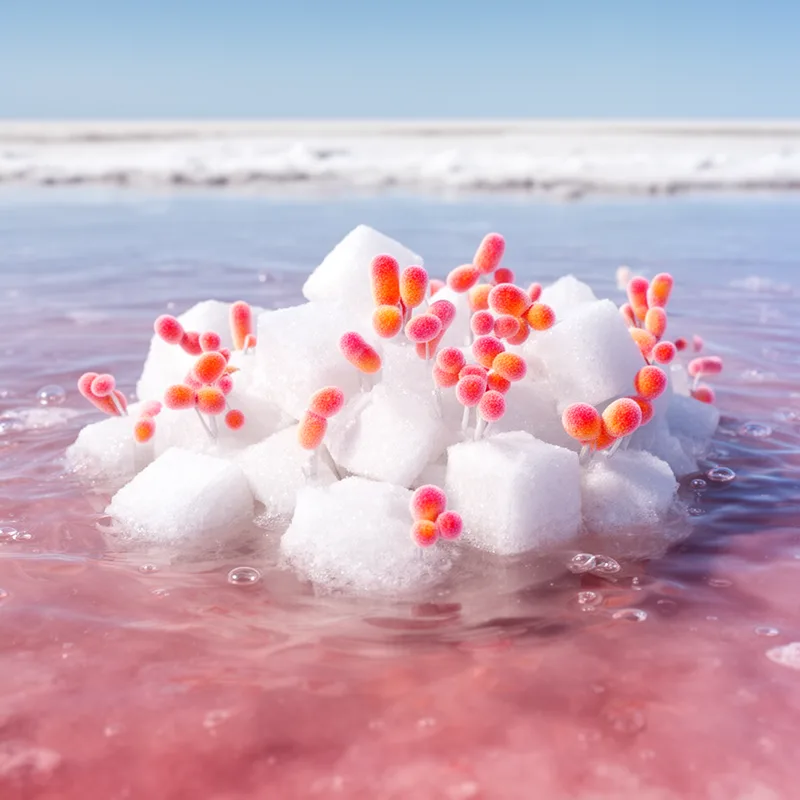
halophilic


 1
9.5
- adjective
- /ˌheɪloʊˈfɪlɪk/
- Specialized
- Vibrio vulnificus is a motile, halophilic, rod-shaped gram-negative pathogen that lives in estuarine environments (1).
Examples
-
The idea of epigenesis will please those researchers who, like the present reviewer, have seen moderately salt-tolerant algae become strongly halophilic when the salt concentration of the growth medium is increased.
Academic text (2003) -
I also work on classic halophilic Archaea.
-
The resulting increase in recharge and runoff leads to a rise in the water table, thereby bringing saline water to the surface, where halophilic vectors of the Ross River virus can exploit these new habitats (see figure 1b).
Academic text (2008) -
Many organisms, such as certain species of blue-green algae, are halophilic and thrive in salty environments.
-
The halophilic bacterium can survive in the extreme salinity of salt flats and saltwater lakes.
-
Research shows that some halophilic microorganisms play a crucial role in maintaining ecosystem balance in saline waters.
Synonyms
 1
9.9
Can grow in salty soil or water
How Salt-Tolerant
- Specialized
1
9.5

- Specialized
1
9.9
Surface Forms
Morphology
halophilic = halophile (semi-transparent) = halo + phil + ic
The base word 'halophile' is clear, but the root 'halo' is not a standalone English word, making it semi-transparent.
Etymology
Halophilic breaks into halo- ('salt') and -philic ('loving'), the same -philic you see in hydrophilic. So a halophilic organism is 'salt-loving' and can live and grow in very salty places, which is why we use the word for bacteria and proteins that thrive in salt.