
half-life
 14
5.6
14
5.6

- noun
- /ˈhæfˌlaɪf/
- Specialized
- Cobalt thorium G has a radioactive half-life of 93 years.
- long half-life
- short half-life
- half-life of minutes
Loading YouTube…
Watch on YouTubeWell, you know, there's a half life for factoids.
- Well, you know, there's a half life for factoids.
- It's like decay, the half life of radium.
- And then they calculate at the end, what is the half life?
- So caffeine has what we call a half life of about five to six hours.
- And for you, THC has the longest half life out of the drug game.
- In fact, the half life in our bodies is from two to five years.
- How do we know what is why this protein has a different kind of half life than some other protein?
- And that's what we call the caffeine crash, which is caffeine has a half life and it's metabolized.
- But what they've done is they modify the protein so that now the half life is much, much longer.
- If you took tadalafil, then it's that's going to be has a long half life.
- Now what is true is that all the atoms of a particular kind have a very repeatable half life.
- And so their half life could be as short as two hours rather than five to six hours.
- The good thing about fast reactors is that they destroy the nuclear waste with the longest half life.
- These things have half lives in the human body of not hours, not days, not weeks or months, but years.
- Usually there's something else is also still radioactive, but it might have a much shorter half life.
- It's half life is years and you know it's not being snapped up because it's not very appealing.
Examples
-
So caffeine has what we call a half life of about five to six hours.
-
The most common way of determining persistence is to consider the half-life of the substance in the environment.
Academic text (2006) -
Some materials have much longer half lives than other materials.
-
In fact, the half life in our bodies is from two to five years.
-
These things have half lives in the human body of not hours, not days, not weeks or months, but years.
-
And so their half life could be as short as two hours rather than five to six hours.
-
The time required to reach a steady concentration depends on the half-life of the drug.
Academic text (2011) -
The knowledge of half-lives of drugs is essential in determining the intervals between drug doses.
Academic text (2011) -
Plutonium, on the other hand, has a half-life of twenty-one thousand years.
Academic text (2008) -
Uranium-238 has a half-life of about 4.5 billion years, making it stable over geological timescales.
How Long

Surface Forms
Morphology
Etymology
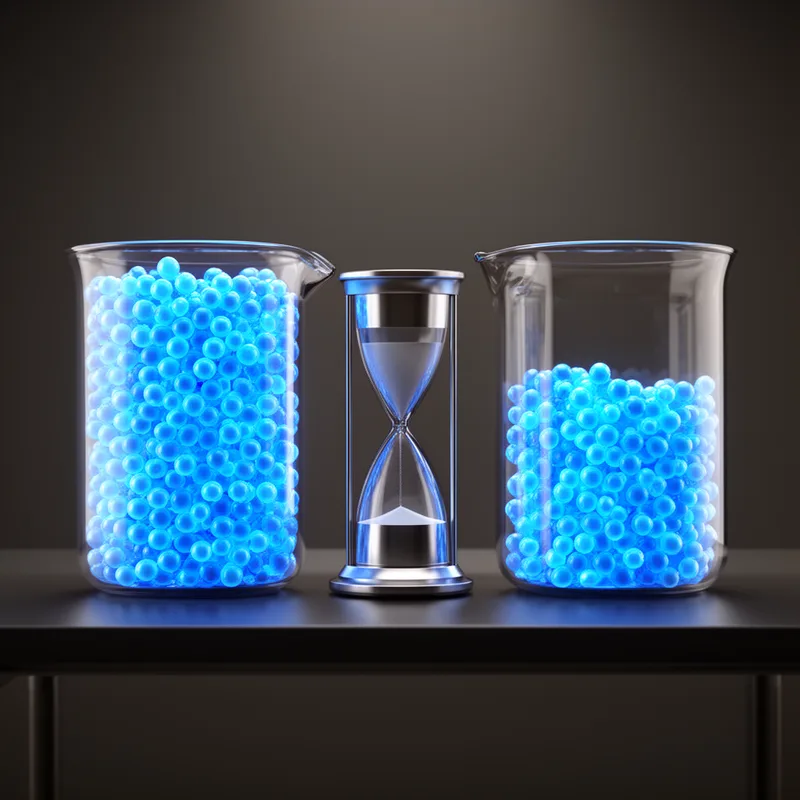
Half-life combines the simple words half ('one of two equal parts') and life ('the time something lasts'). A helpful way to remember it is to imagine the 'life' of something until only 'half' is left, so half-life means the time it takes for an amount, for example a medicine or a radioactive element, to reduce to half its original amount.