
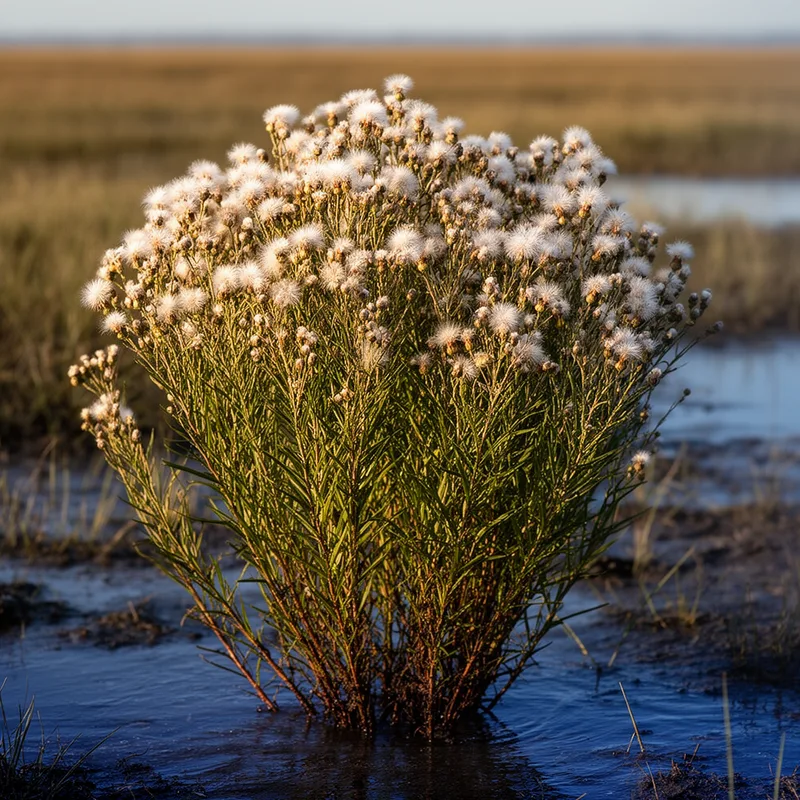
groundsel bush
- noun
- US
- In spring, the groundsel bush blooms with fluffy white tufts that attract many pollinators.
Examples
-
We found many groundsel bushes near the edge of the salt marsh, thriving in the coastal soil.
-
The gardener planted several groundsel bushes along the path to create a natural barrier.
-
In April, she brought the bees back to her place where they could forage on the groundsel bush to stop them starving.
-
Even taller are the shrubby marsh elders and groundsel bushes.
Academic text (1998)
Synonyms
A shrub that grows in salty coastal marshes with seeds in white fluffy tufts

A shrub with white fluffy seeds that grows in salt marshes
A small bush that grows in salt marshes and has fruit with white fluffy tufts

A bush that grows in salt marshes with fruit surrounded by white feathery hairs
Surface Forms
Morphology
The compound 'groundsel bush' is directly compositional: 'groundsel' (a plant/weed) + 'bush' (a small woody plant) yields the meaning 'a bush of the groundsel type', so a B1 learner who knows both constituents will infer it denotes a kind of shrub. Specific ecological or morphological details (salt‑marsh habitat, plumelike tufts) are not predictable from the parts, but the core sense 'a type of bush/plant' is transparently derivable.
Etymology
Groundsel bush may get its name from its tiny fruits with white, fluffy tufts that float like little parachutes and then settle on the ground. So the name helps you remember this marsh bush whose seeds drift and land.

