
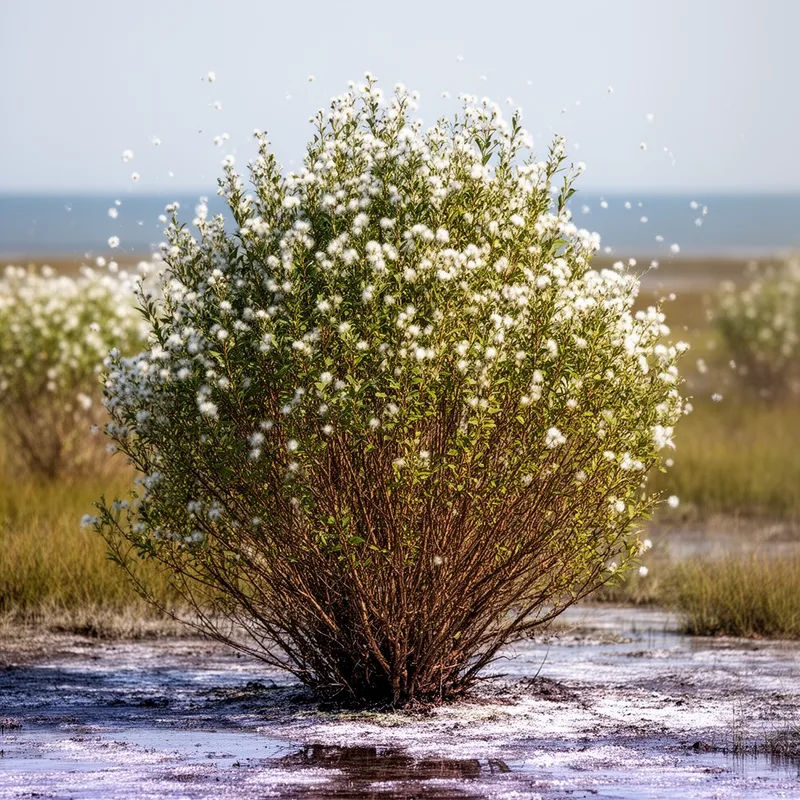
Baccharis halimifolia
- noun
- Specialized
- The seeds of Baccharis halimifolia are dispersed by wind thanks to their fluffy tufts.
Examples
-
The Baccharis halimifolia thrives in coastal salt marshes.
-
Baccharis halimifolia is often used in landscaping due to its tolerance of salty soils.
-
Conservationists monitor Baccharis halimifolia populations in coastal wetlands.
-
Have you seen a Baccharis halimifolia in bloom?
-
Baccharis halimifolia is commonly found growing in salt marshes along the coast.
-
The fluffy tufts of Baccharis halimifolia help its seeds to float on the wind.
-
In addition to its beauty, Baccharis halimifolia provides habitat for local wildlife.
Synonyms

A shrub with white fluffy seeds that grows in salt marshes
A shrub that grows in salt marshes and has white feathery tufts on its fruit

A bush that grows in salt marshes with fruit surrounded by white feathery hairs
A small bush that grows in salt marshes and has fruit with white fluffy tufts
Surface Forms
Morphology
Baccharis + halimifolia
This is a Latin binomial (taxonomic name) rather than an English compositional phrase; the constituents are either specialized proper nouns or unattested to a B1 learner ('halimifolia' is not a common English word). The specific shrub meaning (salt‑marsh shrub with plumelike tufts) cannot be derived from the parts by an average B1 learner, so the expression is idiomatic/label-like rather than transparently compositional.
Etymology
Baccharis halimifolia comes from two parts: Baccharis may come from the god Bacchus because similar plants were used in old celebrations, and halimifolia means 'sea-leaved' or 'salt-loving'. So the name is a handy picture — a shrub tied to old festivals that today grows in salty marshes and sends out fluffy seeds on the wind.

