
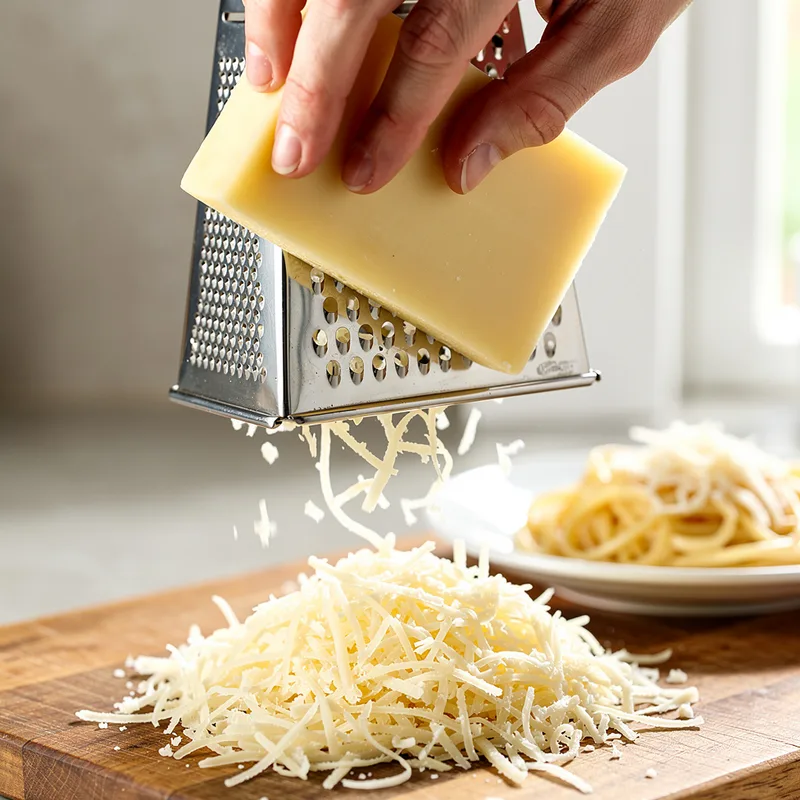
grated cheese
 2
1.0
2
1.0

- noun
- Top the chips with grated cheese and then a nice layer of the chicken fajita topping.
- Sprinkle with grated cheese
- grated cheese on top
- freshly grated cheese
Examples
-
The beans are then mashed, fried in lard, and garnished with grated cheese.
Academic text (2003) -
The fish is cooked in the sauce, stirred into prepared pasta, and garnished with fresh basil and grated cheese.
Blog text (5) -
Sprinkle the grated cheese on top.
Fiction book (1993) -
"Anna grated cheese over the casserole."
Fiction book (1998) -
He sprinkled on grated cheese.
Fiction book (1996) -
I made a recipe from a star chef's cookbook that called for a cup of grated cheese.
Blog text (8) -
We actually put Red Leicester grated cheese on ours with sour cream and chives and bacon bits or onion bits as well.
-
Their idea of "Mexican food" was ground beef in a taco shell with grated cheese, lettuce, and a slice of tomato.
Blog text (22) -
Lightly brush the dough with olive oil, spread the chopped sun-dried tomatoes evenly over the surface of the dough, and sprinkle the grated cheese over the tomatoes.
Blog text (6) -
Sprinkle some grated cheese on top of the pizza before baking.
How Fine


Surface Forms
Morphology
The meaning 'cheese that has been shredded' is directly derivable from combining 'grate' (to shred by rubbing) with 'cheese' (dairy product); the past-participle form 'grated' signals a resulting state. This is a common adjective+noun composition and has clear cross-linguistic equivalents (e.g., Spanish 'queso rallado'), so a B1 learner who knows the constituents will readily understand it.
Etymology
Grated cheese comes from the simple action of rubbing a block of cheese against a grater so it turns into small pieces. 'To grate' means to rub food into thin bits, and that's why grated cheese means cheese already broken into small pieces you can easily sprinkle as a 'topping' or mix into a dish.