
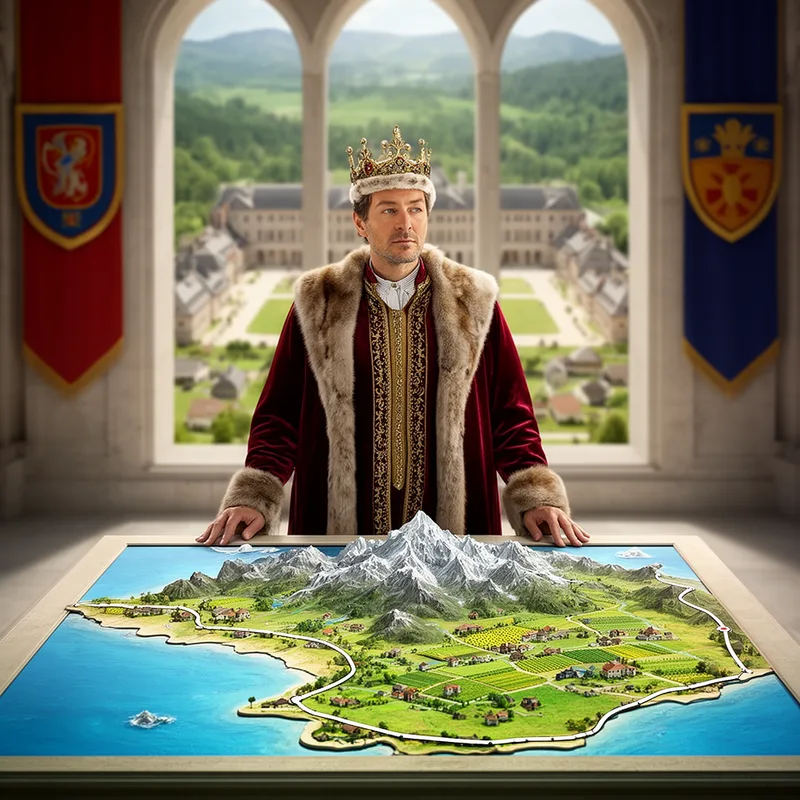
grand duchy
- noun
- /ɡrænd ˈdʌtʃi/
- As the main port of Tuscany and the launching site for the fleet of the Knights of St. Stephen that crusaded against the Turks, Livorno possessed a character distinct from the capital of Florence and the rest of the Grand Duchy.
Examples
-
If this timetable is adhered to, the Grand Duchy would again be Europe's star pupil.
Academic text (1991) -
"This is a Czarist Grand Duchy with bourgeois pretensions."
Fiction book (1996) -
In the Grand Duchy, about 30 percent are foreigners.
Academic text (1991) -
The Grand Duchy of Finland kept the old Swedish administrative system, its legal and cultural institutions, and customs.
Academic text (1992) -
Having defeated Sweden, Tsar Alexander I acquired Finland, but made it an autonomous Grand Duchy of the Russian Empire.
Academic text (1992) -
In Lausanne, she receives bad news from home: Finland's political status as an autonomous Grand Duchy in the Russian Empire is in danger.
Academic text (1999) -
Finland also claimed them because, after Sweden ceded them to Russia in 1809, they had been governed as part of the Grand Duchy of Finland.
Academic text (1995) -
Prior to the first Napoleonic invasion of 1796, Livorno belonged to the Grand Duchy of Tuscany, then under the rule of Ferdinand III of the House of Habsburg-Lorraine.
Academic text (2015) -
True, Ukraine "has been part of Russia for centuries," but it has been no less a part of the Mongol Empire, the Grand Duchy of Lithuania, the Polish Commonwealth, the Habsburg Empire, and the Ottoman Empire.
Academic text (2015) -
The Grand Duchy of Luxembourg is known for its rich history and beautiful landscapes.
Surface Forms
Morphology
Both constituents are compositional: 'duchy' denotes a territory ruled by a duke and 'grand' signals higher rank or importance, so 'grand duchy' straightforwardly denotes a duchy ruled by a grand duke/duchess. This is a regular modifier + noun composition and has clear parallels in many languages, so a B1 learner who knows the parts should be able to infer the meaning.
Etymology
Grand duchy comes from rulers called grand dukes or grand duchesses who led a small country. Imagine a leader called a 'grand' duke, higher than a duke but below a king, and the land he ruled was called a duchy, so a grand duchy means 'the land ruled by a grand duke'.

