
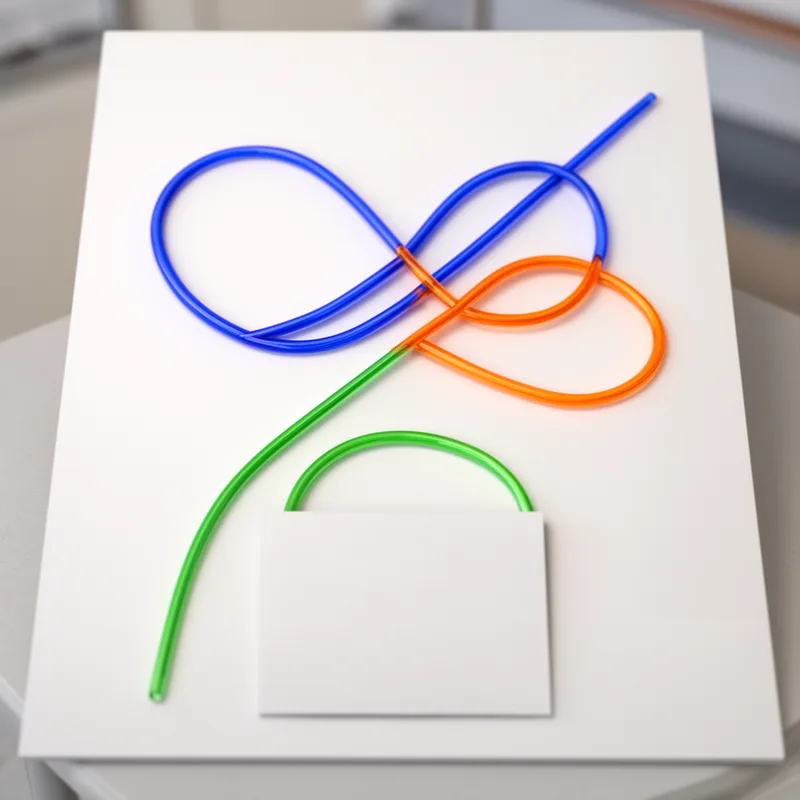
good continuation
- noun
- /ɡʊd kənˌtɪn.juˈeɪ.ʃən/
- Specialized
- Artists often use good continuation to guide the viewer’s eye smoothly across a painting.
Examples
-
The concept of good continuation helps explain why we easily follow the trajectory of a curved road.
-
According to the principle of good continuation, we naturally perceive intersecting lines as two continuous paths rather than abrupt angles.
-
The design uses good continuation to guide the viewer's eye.
-
In art, good continuation helps create a sense of flow.
-
According to the principle of good continuation, we naturally perceive intersecting lines as two continuous paths rather than abrupt angles.
-
Artists often use good continuation to guide the viewer’s eye smoothly across a painting.
-
The concept of good continuation helps explain why we easily follow the trajectory of a curved road.
Synonyms

 1
5.7
1
5.7

The way people see a line as going on even when it is broken

We see lines or patterns as one path that keeps going even when broken
Antonyms


Surface Forms
Morphology
The phrase is literally composed of 'good' + 'continuation', so a learner who knows both words can infer a vague meaning like 'a continuation that is good'. However, the MWE refers to a specific Gestalt psychology principle about perceiving smooth continuation of lines — a technical sense that is not fully predictable from the parts for an average B1 learner, so it is only partially transparent.
Etymology
Good continuation comes from a simple image: imagine a line or road that keeps going in a smooth direction. The words good and continuation show the idea that we 'follow' the smooth path, so we 'see' lines or shapes as continuing instead of suddenly stopping.