

continuation
 1
5.7
1
5.7

- noun
- /kənˌtɪnueɪʃən/
- Specialized
- Her use of bright colors emphasized the continuation of the pattern throughout the entire mural.
Examples
-
The Eastern Building, added in 1933 during the first French period and heightened in 1958, is visible at the upper right in the continuation of the meridian building.
Academic text (2005) -
Despite the title, this post is actually not a continuation of my debate with Dan about the rationality of elite institutions.
Blog text (31) -
He has his shirt off, so that his bald head seems a natural continuation of his bare skin.
Fiction book (1990) -
The continuation of the straight line made it easy for the artist to draw the next section.
-
In psychology, the continuation principle explains why we perceive disconnected lines as part of the same flow.
Synonyms

We see lines or patterns as one path that keeps going even when broken
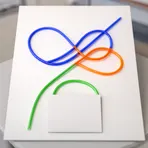
We see lines or shapes as continuing in a smooth path
Antonyms

Compounds
- Specialized
We see lines or patterns as one path that keeps going even when broken
How Continuous
1
4.9
 259
1.6
259
1.6
- Specialized
1
5.7
99
3.0
9
7.8
Surface Forms
Morphology
Etymology
Continuation comes from the verb continue, built from Latin parts con- ('together') and tenere ('to hold'). In design and perception, a continuation is the idea that a line or shape seems to 'go on', so our eye follows it as if it were not broken.