
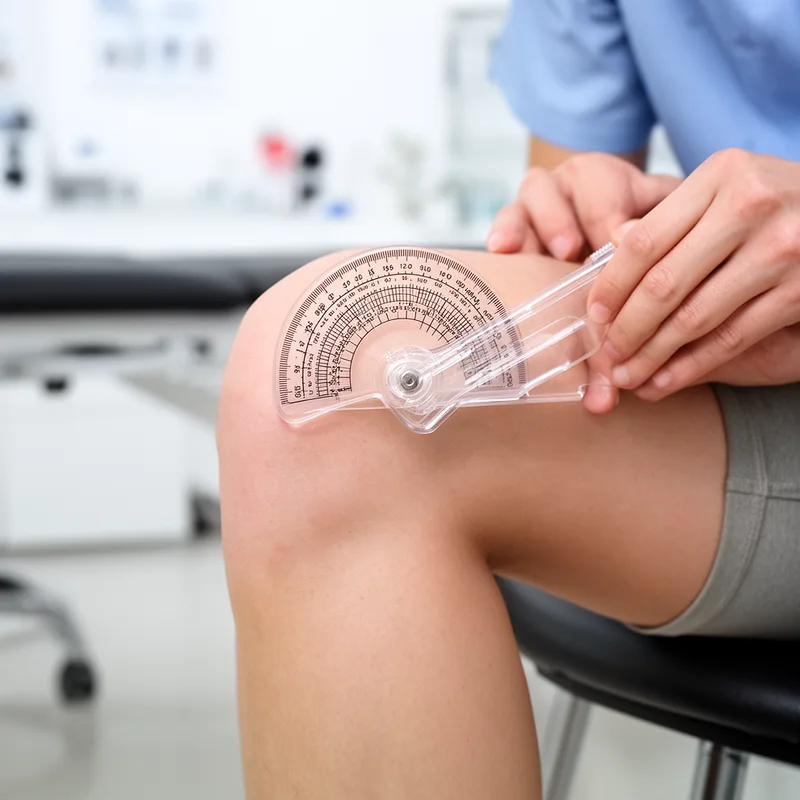
goniometer
- noun
- /ˌɡoʊniˈɑːmɪtər/
- Specialized
- The therapist used a goniometer to measure the patient's joint angles during rehabilitation.
- a universal goniometer
- goniometer to measure
- a standard goniometer
Examples
-
Active range of motion was measured using a two-arm goniometer.
Academic text (2014) -
Active range of motion of the hip and knee was measured with a standard manual goniometer with long telescopic shanks.
Academic text (2000) -
The goniometer was held 10 cm away at the infants' eye level.
Academic text (2015) -
There was a 1.5-degree change as measured by a standard universal goniometer from day to day.
Academic text (2001) -
The mean of the three goniometer measurements was calculated for each joint angle parameter.
Academic text (1994) -
The ensuing deflection of the foot is read from the goniometer.
Academic text (1991) -
The angle of inclination was monitored by a reference goniometer affixed to the tilt table.
Academic text (2000) -
Flexion was measured with a goniometer from 0 to 180 (full flexion).
Academic text (2006) -
Finally, the anatomic landmarks in the foot and leg used to align the goniometer can be deceptively difficult to localize.
Academic text (2001) -
The medial or lateral torsion is measured on the goniometer clamped to the great toe.
Academic text (1991)
Synonyms
 1
8.0
1
8.0

A tool that measures small changes in how the ground or a building leans


 1
9.9
1
9.9
A tool people use to measure side-to-side and up-and-down angles on land
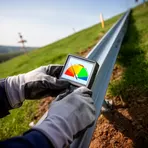
A tool that measures how much something tilts, like land or a plane
A tool that measures how steep a slope is

A tool used to measure directions or angles when mapping land
How Precise

Surface Forms
Morphology
Etymology
The word goniometer comes from Greek parts goni 'angle' and -meter 'measure'. So, it is literally an 'angle measurer', like a school protractor or a thermometer, and therapists or scientists use a goniometer to measure angles in joints or crystals.