

god of war
 8
8.3
8
8.3

- noun
- Literature
- In mythology, Ares is often depicted as the god of war who embodies chaos and violence.
- Ares, god of war
Loading YouTube…
Watch on YouTubeAnd Mars or Aries, the God of War, gives a cup of the river of Lefe to each of the warriors that fight.
- And Mars or Aries, the God of War, gives a cup of the river of Lefe to each of the warriors that fight.
Examples
-
Remember that I walk accompanied by the God of War and by the God of Fortune.
-
I am Mars, god of war!
-
We should pray to the god of war.
-
Mars, the god of war.
Fiction book (2001) -
Ares is the god of war, right?
-
This is Wotan, our god of war.
-
The god of war.
-
Mars, god of war.
-
Tyr, whose name gave us Tuesday, was a god of war and justice, equated to the Roman Mars.
Academic text (1990) -
This temple is dedicated to the god of war for avenging Rome after the assassination of Julius Caesar.
Academic text (2007)
Synonyms
 62
7.4
62
7.4
A god or goddess that people worship and think has power over part of the world


 1
8.0
1
8.0
A god people pray to for victory in battle
 1
8.2
1
8.2
A female figure in myths who fights in wars and protects people

A Hindu god of war and courage, son of Shiva and Parvati and leader of the gods' army

A Shinto god of war who protects Japan and its people
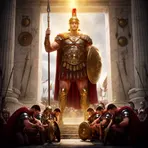
A Roman god or spirit of courage and strength in war
Surface Forms
Morphology
The meaning is directly compositional: 'god' (deity) combined with the relational preposition 'of' and 'war' yields a deity associated with or having power over war, so the overall sense is derivable from the constituents. This noun + of + noun pattern is cross-linguistically common (e.g., Spanish 'dios de la guerra') and follows a standard possessive/relational construction, making it immediately understandable to a B1 learner who knows the words.
Etymology
God of war comes from how ancient people imagined a powerful god who controlled war and helped fighters win. Armies would pray to that god before battle, so the phrase came to mean 'a god who gives victory in battle'.