

glider
 37
4.6
37
4.6

- noun
- /ˈɡlaɪdər/
- Specialized
- In 1901, they went aloft in tethered gliders and were disappointed in the results.
- pilot a glider
- a hang glider
- a glider flight
Loading YouTube…
Watch on YouTubeThat's that's telling us up in the hang glider behind the plane.
- That's that's telling us up in the hang glider behind the plane.
- So on the kit it's got a painting of glider pilots landing on D-Day.
- And with all gliders, you're constantly trading height for speed.
- An airplane whose engine fails is a, is a glider.
- And then I went to flying hang gliders with motors and now I fly gyrocopters, right.
- Let's eject some hard drives from this balloon and bring them down on a glider or a parachute during the mission.
Examples
-
They planned their flight in the glider to take advantage of the strong afternoon winds.
-
The glider soared gracefully through the sky, relying on the uplift of warm air currents.
-
Meet me down by the glider.
-
Without a sound, the glider had touched down on the grass and rolled to a stop.
Fiction book (1992) -
I don't think the glider can take it.
-
For the moment, however, the planes are the world's largest gliders because they have no engines.
Academic text (2011) -
And with all gliders, you're constantly trading height for speed.
-
Lilienthal and Pilcher planned to use their gliders as steps toward powered flight.
Academic text (2003) -
June 6, 1944, the Horsa British glider crash-landed alongside the Caen Canal in Northern France.
Academic text (2009) -
After several lessons, she finally felt confident enough to pilot a glider on her own.
Synonyms
 1
8.1
1
8.1
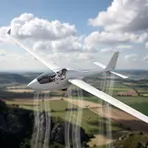
A light plane without an engine that flies using rising air
Compounds
 2
4.2
2
4.2
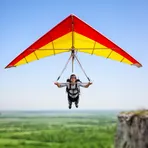
A light flying craft without a motor like a large kite that a person hangs under to fly
How Big
9
3.0
 58
2.6
818
2.5
58
2.6
818
2.5
- Specialized
37
4.6
- Specialized
5
5.1
Surface Forms
Morphology
Etymology
Glider comes from the verb glide, which means 'move smoothly', plus the ending -er meaning 'one that does something'. So a glider is literally 'one that moves smoothly', which fits an aircraft that stays in the air by sliding on the wind without an engine.