
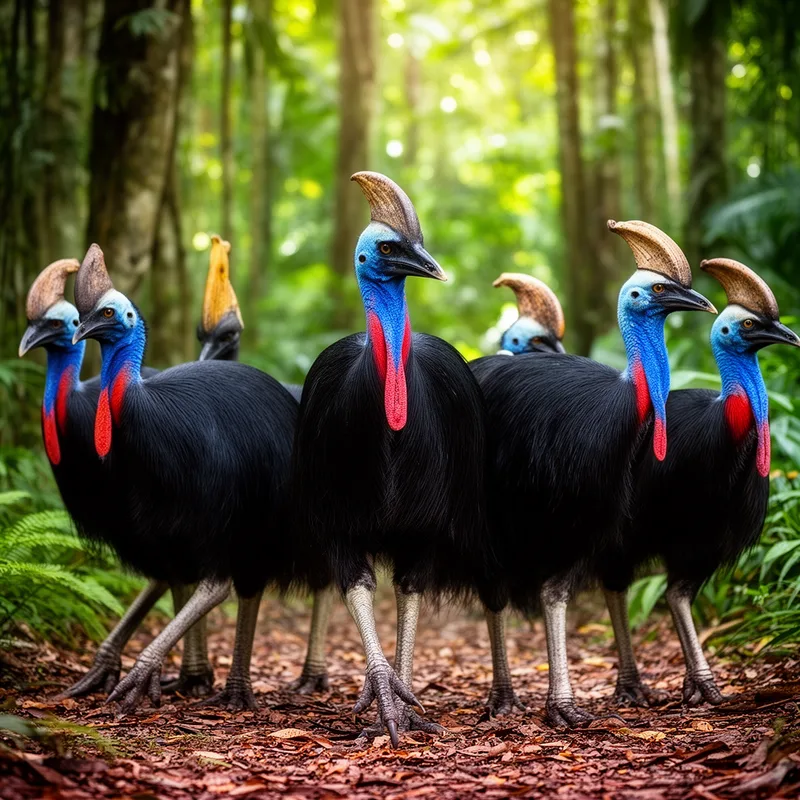
genus Casuarius
- noun
- /ˈdʒɛnəs ˈkæzʊˌɛriəs/
- Specialized
- The southern cassowary, a member of the genus Casuarius, is known for its distinctive casque.
Examples
-
The genus Casuarius includes all living species of cassowaries found in Australia and New Guinea.
-
Scientists have studied the evolutionary history of birds within the genus Casuarius.
-
The genus Casuarius includes several species of cassowaries.
-
Did you know that the genus Casuarius is unique to New Guinea?
-
The genus Casuarius encompasses the large, flightless birds known as cassowaries.
-
In the genus Casuarius, the southern cassowary is particularly notable for its bright blue and black feathers.
-
Researchers classify the large cassowaries into the genus Casuarius based on their unique physical characteristics.
Synonyms
A group of large flightless birds called cassowaries from Australia and New Guinea
Surface Forms
Morphology
The phrase combines the common noun 'genus' (a biological rank) with the proper name 'Casuarius' (the cassowary genus), so its meaning — the genus named Casuarius comprising cassowary species — is directly derivable from the constituents. This taxonomic compositional pattern is standard cross-linguistically and should be transparent to a B1 learner who knows both words.
Etymology
Genus Casuarius may come from a Malay word for the big, helmeted bird called the 'cassowary', and naturalists later used the Latin form Casuarius. So, genus Casuarius now names the single group of large, flightless birds we know as 'cassowaries'.

