
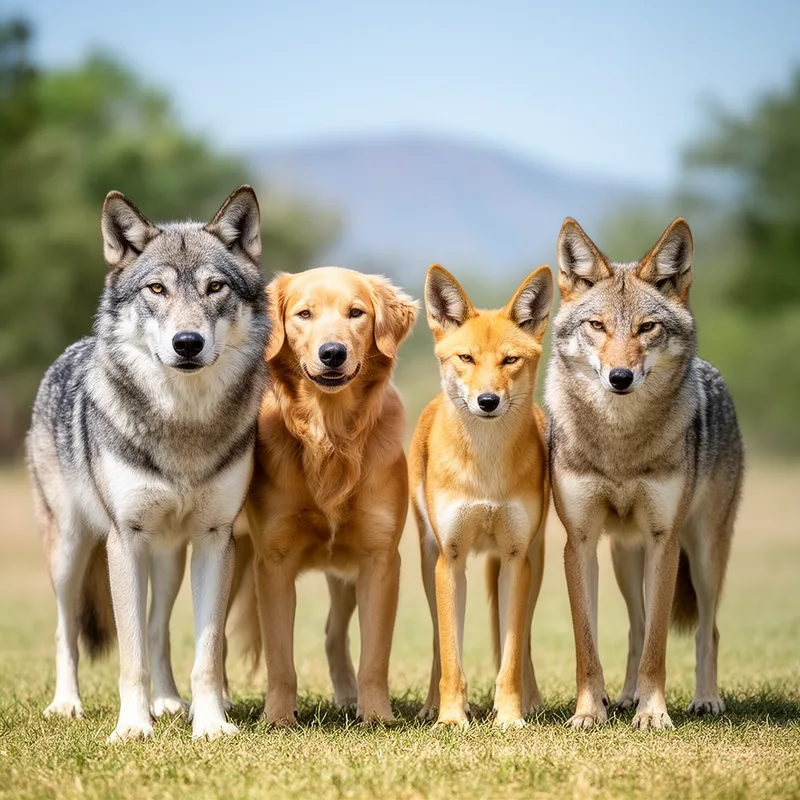
genus Canis
- noun
- /ˈdʒiːnəs ˈkeɪnɪs/
- Specialized
- The genus Canis includes dogs and wolves, which are descendants of a common ancestor.
Examples
-
Scientists discovered a new species within the genus Canis, adding to our understanding of canine evolution.
-
From about the beginning of the Pleistocene, the genus Canis has had a continuous presence in Eurasia, along with various species of fox and raccoon dog.
Academic text (2008) -
The first member of the genus Canis—to which the gray wolf, coyotes, jackals, and the domesticated dog belong—loped onto the scene about 6 million years ago.
Academic text (2008) -
Biologists classify the domestic dog under the genus Canis due to its close relation to wolves.
Synonyms

 1
7.2
1
7.2

A group of animals in the dog family that includes dogs and wolves
Surface Forms
Morphology
The phrase is fully compositional: 'genus' denotes a biological rank and 'Canis' is the name of that genus, so a learner who knows both words can infer it refers to the taxonomic group named Canis (wolves, dogs, jackals). This is a cross-linguistically regular naming pattern in biological classification, making the meaning directly derivable from the constituents.
Etymology
Genus Canis comes from early scientific naming: genus means 'group' and Canis is Latin for 'dog'. That's why the name points to a group of dog-like animals and is used for the group that includes domestic dogs, wolves and jackals.