

to garnish with
 9
3.5
9
3.5

- phrasal verb
- /ˈɡɑrnɪʃ wɪð/
- You may want to garnish it with sweet basil or Thai basil leaves before serving.
- garnish with parsley
- garnish with cilantro
- garnish with lemon
Loading YouTube…
Watch on YouTubeFirst you want a garlic onion and then garnish with this green onion, Chinese onion.
- First you want a garlic onion and then garnish with this green onion, Chinese onion.
- It's Mox Clamato mixed with Smirnoff vodka and cocktail shrimp garnished with lime wedge and pickled beans.
Examples
-
It's hard to resist succulent pork buns, especially when they are fried and garnished with fresh spring onion and toasted sesame.
Blog text (27) -
When ready to serve, ladle porridge into bowls and garnish with the leek-onion-garlic mixture.
Academic text (2004) -
"The chicken was garnished with rosemary," I say.
Fiction book (2001) -
So tip for you, if you make this, garnish it with fresh basil.
-
Let's also garnish it with my shredded cheese.
-
Pour hot chocolate in the mugs and garnish with whipped cream and marshmallows.
Blog text (10) -
The fish is cooked in the sauce, stirred into prepared pasta, and garnished with fresh basil and grated cheese.
Blog text (5) -
When I visit, she takes me to wonderful restaurants where they serve black-eyed peas garnished with cilantro and spoonbread hot with chiles.
Fiction book (1990) -
"The braised sweetbreads garnished with truffles, mushrooms, and olives were absolutely beyond reproach," Jonathan continued.
Fiction book (2001) -
Pour the mixture into a margarita glass and garnish with a lime slice.
Synonyms
 15
3.5
15
3.5
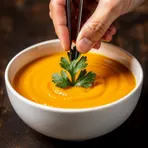
To decorate food with small pieces to add color and flavor
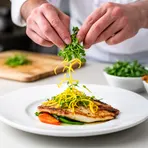
To add small food items, like herbs or lemon peel, to a dish to make it look nicer
Antonyms

How Decorative

Surface Forms
Morphology
The meaning 'to decorate or enhance a dish by adding small food items' is directly compositional from 'garnish' (to add decorative or flavoring items) plus the preposition 'with' (indicating the thing used). This verb + preposition pattern is straightforward and cross-linguistically common (e.g., Spanish 'adornar/decorar con'), so a B1 learner who knows both constituents should be able to infer the MWE meaning.
Etymology
Garnish with comes from the simple picture of adding a small, pretty piece of food—like fresh herbs or a lemon slice—on top of a plate. The little piece is the garnish and with shows what you add, so to garnish with something means 'to decorate' or 'enhance' a dish before serving.