

garden balm
- noun
- /ˈɡɑrdən bɑlm/
- She planted garden balm along the path to attract bees and add fragrance to the garden.
Examples
-
The leaves of garden balm are often used in herbal teas for their soothing properties.
-
The garden balm thrives best in well-drained soil and plenty of sunlight.
-
After escaping from the garden, garden balm now grows wild in several nearby meadows.
-
I planted garden balm in my backyard.
-
The garden balm grows well in sunny areas.
-
She planted garden balm along the path to attract bees and add fragrance to the garden.
-
The leaves of garden balm are often used in herbal teas for their soothing properties.
Synonyms
 1
3.0
1
3.0

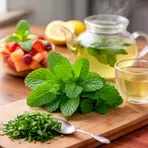
A herb with lemon-scented leaves used in cooking and teas

A bushy herb in the mint family with lemon-scented leaves, also called lemon balm

A lemon-scented herb used in teas and cooking, also called lemon balm

A low-growing herb with lemon-scented leaves used to make calming tea
Surface Forms
Morphology
The compound 'garden balm' is partially compositional: 'garden' signals a plant grown in gardens and 'balm' suggests a soothing plant or substance, so learners can guess it refers to a balmy/medicinal plant. However, the specific identity as the herb 'lemon balm' and the botanical sense of 'balm' may not be fully predictable for a B1 learner who knows only the basic senses of the constituents, making the link only partially transparent.
Etymology
The noun garden balm comes from two words: garden (where it was grown) and balm (an old word for something that 'soothes' or heals). Because people grew this lemon-scented plant in gardens to make tea and calm themselves, garden balm now means the soothing, lemon-scented herb used in gardens and teas.