
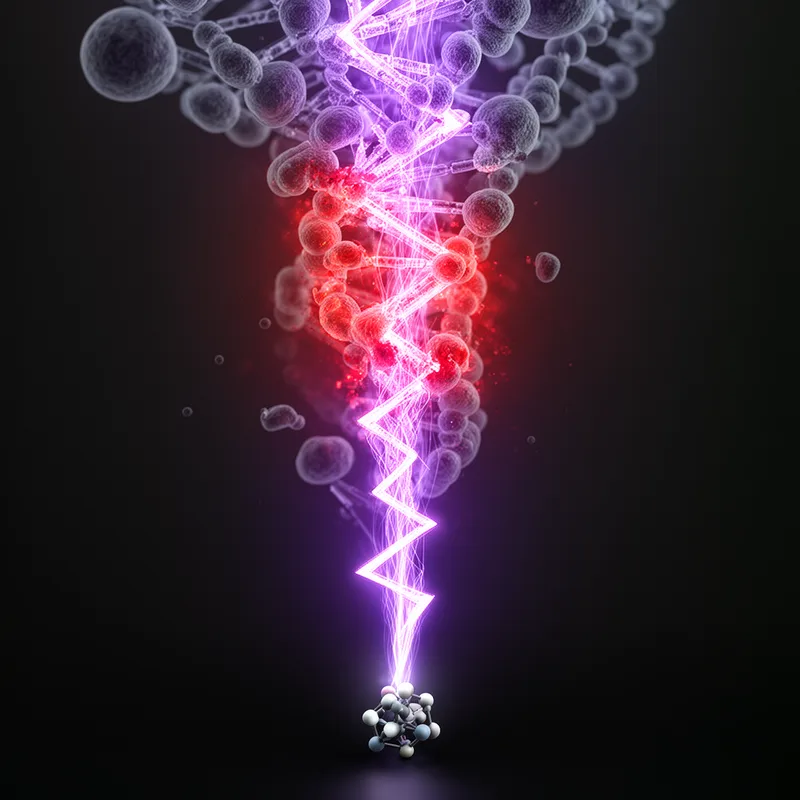
gamma ray
 21
4.2
21
4.2

- noun
- /ˈɡæmə reɪ/
- Specialized
- EGRET is also able to observe the high-energy portion of gamma-ray bursts and solar flares.
- gamma ray burst
- gamma-ray energy
- gamma-ray source
Loading YouTube…
Watch on YouTubeSo there's a Compton gamma ray telescope up there.
- So there's a Compton gamma ray telescope up there.
- And when I say light, I mean every possible form of light from gamma rays, X-rays, infrared light that we think of as heat, radio waves.
- That breakout will should will produce a burst of gamma rays and hard X-rays very high energy radiation for a few seconds.
- Well, because you have the gamma rays and, and it's sort of they sort of lift you up and give you a kind of and then you can transform much easier.
Examples
-
When this radiactive substance decays, it emits gamma rays, which we detect.
-
GRO instruments are much larger and more sensitive than any gamma-ray instruments ever flown in space.
Academic text (1990) -
In fact, the maps show that the gamma-ray sky is not really dark in any direction.
Academic text (2012) -
The crystals are similar in design and size to those used in gamma-ray imaging cameras for medical purposes.
Academic text (1990) -
On the short wavelength end, we have our gamma rays and cosmic rays.
-
The absence of radio counterparts for most of them implies that the gamma-ray beams are very broad.
Academic text (2012) -
Other telescopes picked up a burst of gamma rays and a flash of light and later X-rays and radio signals, all from the same impact.
-
A solar flare on 7 March of this year produced gamma rays with energies up to 4 GeV.
Academic text (2012) -
There are two main sources of gamma ray bursts, mergers of neutron stars and the core collapses of gigantic stars called hypernovae.
-
When this radioactive substance decays, it emits gamma rays, which we can detect with special instruments.
Synonyms
 7
5.5
7
5.5
Very strong energy rays released by radioactive materials
How Energetic
- Specialized
21
4.2

- Specialized
99
3.2
- Specialized
14
5.1
- Specialized
10
3.4
- Specialized
5
4.8
- Specialized
55
3.7
- Specialized
19
3.2
Surface Forms
Morphology
A learner who knows 'gamma' as a letter/label and 'ray' as a beam can transparently infer that 'gamma ray' denotes a kind or class of ray, so the basic compositional relation is clear. However, the specific technical properties (very short wavelength, extremely high energy, radioactive origin) are not derivable from the constituents alone and require specialist knowledge, so the expression is only partially predictable to a B1 learner.
Etymology
The name gamma ray came from early studies of radioactivity, when scientists found three kinds of rays and called them alpha, beta, and gamma. Because 'ray' already meant a beam like an X-ray, the strong third kind was named a gamma ray, so today gamma ray means a very high-energy form of radiation.