
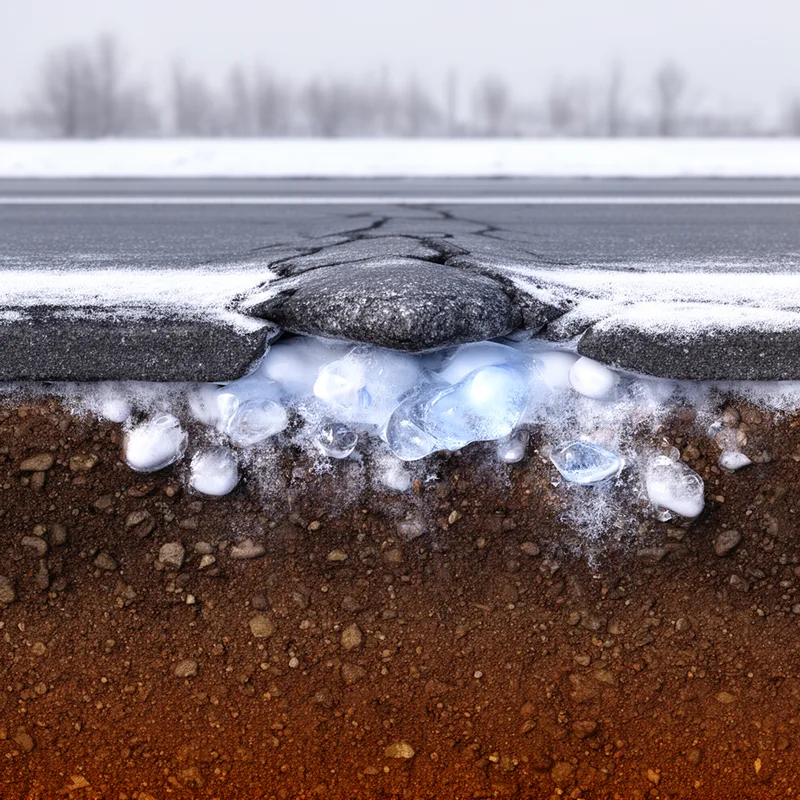
frost heaving
- noun
- UK
- The garden path was uneven after a season of frost heaving.
Examples
-
The frost heaving caused cracks in the pavement.
-
Severe frost heaving can damage roads and sidewalks during harsh winters.
-
To prevent frost heaving, engineers often use gravel or sand under foundations.
-
After the winter, frost heaving was evident in the garden.
-
Frost heaving can cause serious damage to frost heaving if the ground underneath freezes and thaws frequently.
-
During winter, frost heaving can lead to uneven pavement surfaces as the soil expands and contracts.
-
Farmers need to be aware of frost heaving, as it can lift and disrupt the roots of newly planted crops.
Synonyms

Soil or road that rises when water in the ground freezes and expands
Surface Forms
Morphology
The noun combines 'frost' (ice formation) with 'heaving' (bulging or being forced upward), so a learner who knows both constituents can infer an upward movement caused by freezing. This is a straightforward, compositional compound used in technical contexts and mirrors similar constructions in other languages, making it transparent to B1 learners who know the words.
Etymology
Frost heaving comes from the simple image of frost (ice) forming in the ground and heaving (lifting) the soil, stones or pavement up, so it means 'soil or pavement pushed up by freezing water'.

