
frost heave
- noun
- /frɔst hiːv/
- UK
Examples
-
The husband, whose name was Ronald Wilson, telephoned Ace and asked if there were any problems he should know about in the area regarding water-drainage patterns or frost heaves.
Fiction book (1996) -
Regardless of the agents—dogs, elves, or frost heaves—the walls come down and the men meet in springtime to rebuild the barrier separating them.
Academic text (2008) -
"Something there is that doesn't love a wall," he inverts syntax to begin colloquially and obliquely with his namesake, the New England "frost-heave" that disrupts regular lines in roads, walls, and landscapes.
Academic text (2008) -
In Anchorage, Alaska, frost heave can cause the ground to shift, making it difficult to build stable structures.
-
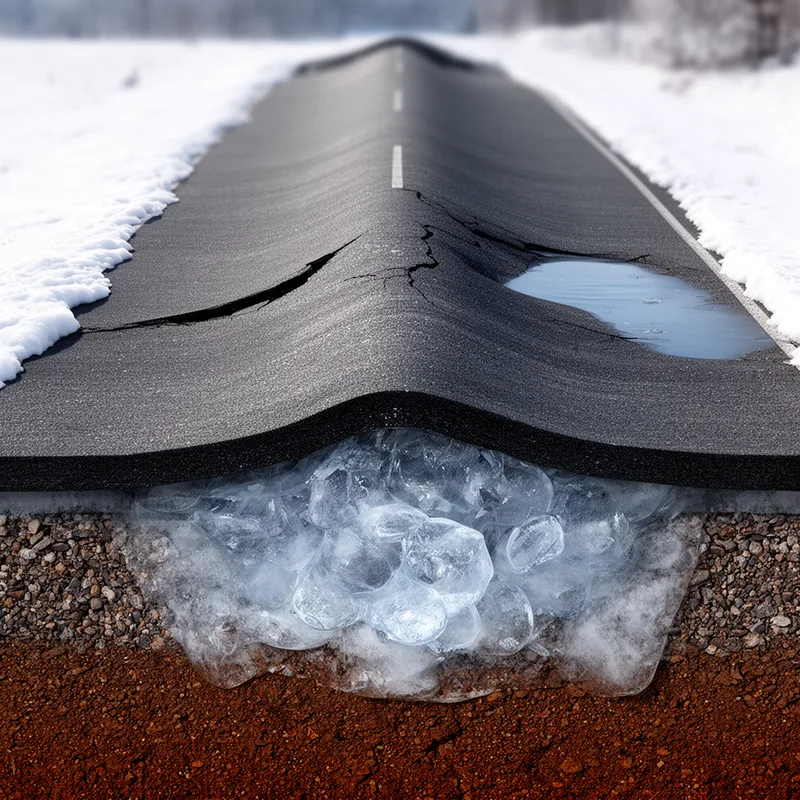
During the winter, frost heave can create bumps and cracks in the pavement, leading to safety hazards for drivers.
-
The contractor warned us about frost heave affecting the foundation of the new home due to the freezing temperatures.
Synonyms

Upward movement of ground or pavement when water in it freezes and expands
Surface Forms
Morphology
The compound presents a clear cause–result composition: 'frost' (freezing moisture) + 'heave' (to bulge or be forced upward) directly yields the meaning 'upward movement caused by frost.' Although the term is technical, the semantic combination is straightforward and therefore a B1 learner who knows both constituents can infer the meaning.
Etymology
Frost heave comes from a winter picture: when wet ground freezes, the frost forms and the ground heaves, and the word heave means to 'lift' or 'push up'. So, frost heave means the upward movement of soil or pavement when freezing water pushes it up.

